KEY TAKEAWAYS
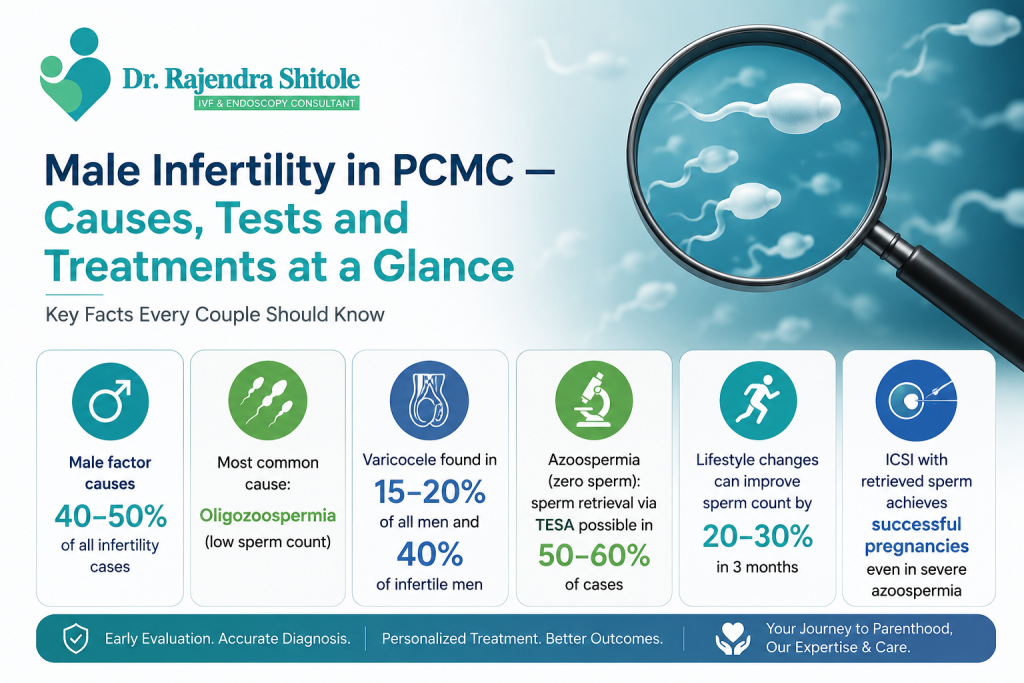
Male factor is responsible for 40 to 50 percent of all infertility cases — making it equally important to test both partners.
A semen analysis is the first and most important male fertility test — it costs INR 500 to 1,500 in PCMC.
Varicocele, the most common treatable cause of male infertility, is found in 40 percent of infertile men.
Even in complete azoospermia (zero sperm), surgical retrieval (TESA/PESA) can recover sperm in 50 to 60 percent of cases.
IVF with ICSI using surgically retrieved sperm achieves successful pregnancies in PCMC.
Lifestyle changes — quitting tobacco, improving BMI, reducing alcohol — can improve sperm parameters within 3 months.
Is Male Infertility Common in PCMC?
Male infertility treatment in PCMC 2026 is more in demand than ever, yet male infertility remains underdiscussed. According to ICMR 2024 data, male factor contributes to 40 to 50 percent of all infertility cases in India. Yet men are often the last to be tested. At Dr. Shitole’s fertility clinic in Pimpri-Chinchwad, every couple starts with a simultaneous assessment of both partners — because infertility is never just a woman’s issue.
This guide covers the full spectrum of male infertility treatments available in PCMC: from simple lifestyle changes and medications to surgical sperm retrieval and IVF-ICSI. It’s written to inform, not to alarm.
QUICK FACTS
Semen Analysis Cost in PCMC: INR 500 to 1,500
Sperm DNA Fragmentation Test Cost: INR 3,000 to 6,000
Varicocele Repair Cost (PCMC): INR 40,000 to 80,000
TESA/PESA Procedure Cost (PCMC): INR 15,000 to 30,000
IVF-ICSI with TESA Sperm (PCMC): INR 1,50,000 to 2,20,000
Time for lifestyle changes to improve sperm: 3 months (one spermatogenesis cycle)
PCMC Male Infertility Statistics 2025-2026
| Metric | Data Point | Source |
| Male factor contribution to infertility | 40 to 50 percent | ICMR 2024 |
| Prevalence of varicocele in infertile men | Approx. 40 percent | ICMR 2024 |
| Azoospermia prevalence in infertile men | 10 to 15 percent | Industry estimate |
| TESA success rate (sperm found) | 50 to 60 percent in non-obstructive azoospermia | Industry estimate |
| Semen analysis abnormality rate in India | 1 in 3 men tested | ICMR 2024 |
| IVF-ICSI success with TESA sperm (PCMC) | 35 to 50 percent per cycle | Industry estimate |
| Improvement in sperm count with lifestyle changes | 20 to 30 percent in 3 months | Industry estimate |
| Tobacco use and sperm count reduction | 22 percent lower count in smokers | PubMed 2020 |
What Causes Male Infertility?
Male infertility has multiple causes. Understanding the cause is essential before choosing a treatment.
| Cause | Prevalence | Treatment Options |
| Oligozoospermia (low count) | Most common | Lifestyle, hormonal treatment, IVF-ICSI |
| Asthenozoospermia (poor motility) | Common | Antioxidants, lifestyle, IVF-ICSI |
| Teratozoospermia (abnormal morphology) | Common | IVF-ICSI, lifestyle |
| Varicocele | 40 percent of infertile men | Varicocelectomy surgery |
| Obstructive azoospermia | 40 percent of azoospermia | PESA/TESA sperm retrieval + ICSI |
| Non-obstructive azoospermia | 60 percent of azoospermia | Micro-TESE + ICSI |
| Hormonal causes (low testosterone/FSH) | 5 to 10 percent | Hormonal therapy |
| Sperm DNA fragmentation | Up to 25 percent of infertile men | Antioxidants, TESA, IVF-ICSI |
Semen Analysis — The First Step for Men in PCMC
A semen analysis is the foundational test for male fertility. It costs INR 500 to 1,500 in PCMC and gives results within 24 to 48 hours. The test measures sperm concentration, total count, progressive motility, total motility, morphology (shape) and volume.
Normal parameters (WHO 2021 reference values): count above 16 million/mL, progressive motility above 30 percent, normal morphology above 4 percent. If any parameter falls outside normal range, further testing is arranged. Dr. Shitole’s clinic also offers sperm DNA fragmentation testing (DFI) for men with unexplained IVF failure or recurrent miscarriage.
Varicocele Treatment in PCMC — Does Surgery Help?
Varicocele is an enlargement of the veins within the scrotum, similar to varicose veins. It raises scrotal temperature and increases oxidative stress on sperm, damaging count, motility and DNA integrity. Varicocelectomy — surgical ligation of the affected veins — is the most common male fertility surgery performed at PCMC clinics.
The evidence for varicocele repair improving natural conception rates is moderate. For couples planning IVF-ICSI, the benefit is clearer — improved sperm parameters after varicocelectomy lead to better ICSI fertilisation rates. Surgery cost in PCMC ranges from INR 40,000 to 80,000 depending on approach (open, laparoscopic or microsurgical).
TESA and PESA — Surgical Sperm Retrieval in PCMC
For men with azoospermia (zero sperm in ejaculate), sperm can often be retrieved directly from the testis or epididymis.
- PESA (Percutaneous Epididymal Sperm Aspiration): Needle aspiration from epididymis. Used in obstructive azoospermia. Simpler, less invasive.
- TESA (Testicular Sperm Extraction): Fine needle aspiration directly from testicular tissue. Used in obstructive and some non-obstructive cases.
- Micro-TESE (Microsurgical TESE): Advanced microsurgical dissection of testicular tissue to find sperm in non-obstructive azoospermia. Highest sperm retrieval rate.
Retrieved sperm are used immediately for ICSI or frozen for future cycles. TESA procedure cost in PCMC ranges from INR 15,000 to 30,000. Combined IVF-ICSI with TESA sperm costs INR 1,50,000 to 2,20,000 in total.
Lifestyle Changes That Improve Male Fertility in PCMC
Three months of targeted lifestyle changes can meaningfully improve sperm parameters in many men. This is because spermatogenesis — the production of new sperm — takes approximately 74 days. Improvements made today show up in semen analysis 3 months later.
| Change | Evidence | Expected Benefit |
| Stop smoking tobacco | Strong — PubMed 2020 | Up to 22 percent improvement in count |
| Reduce or stop alcohol | Moderate — ICMR | Improved testosterone and motility |
| Reach BMI 18.5 to 24.9 | Strong | Better testosterone, reduced oxidative stress |
| Daily antioxidant supplements | Moderate — PubMed | Reduced DNA fragmentation |
| Sleep 7 to 9 hours | Moderate | Improved testosterone production |
| Avoid heat (laptops, hot baths) | Good | Reduces scrotal temperature, improves count |
| Moderate exercise 4x per week | Good | Improves testosterone and sperm quality |
Male Infertility Treatment in PCMC — Local Context
Men in PCMC’s industrial and IT workforce face specific fertility risk factors: prolonged laptop use, sedentary work, chronic occupational stress, shift work and tobacco use. These are all modifiable. Dr. Shitole’s clinic at D.Y. Patil Hospital, Pimpri-Chinchwad offers a dedicated male fertility consultation that addresses both the clinical findings and the lifestyle factors specific to PCMC’s working population.
Couples from Bhosari, Chinchwad, Akurdi, Moshi and Nigdi regularly visit for combined male and female fertility assessments. The consultation is non-judgmental and comprehensive. A semen analysis and consultation can be completed in a single visit.
Frequently Asked Questions
Q: What is the most common male infertility treatment in PCMC?
The most common treatment is IVF-ICSI, which overcomes most male factor infertility by injecting a single sperm directly into each egg. For men with treatable causes like varicocele, surgery may be recommended first. Lifestyle modifications are recommended for all patients regardless of treatment plan.
Q: Can a man with zero sperm count father a child?
In many cases, yes. Men with obstructive azoospermia almost always have sperm retrievable via PESA or TESA. Men with non-obstructive azoospermia have a 50 to 60 percent chance of sperm being found via micro-TESE. Retrieved sperm are used for ICSI to fertilise eggs. Success depends on the cause of azoospermia and sperm quality found.
Q: How much does a semen analysis cost in PCMC?
Semen analysis costs INR 500 to 1,500 at established fertility clinics and diagnostic labs in PCMC. Advanced sperm DNA fragmentation (DFI) testing costs INR 3,000 to 6,000. Results are usually available within 24 to 48 hours.
Q: Does varicocele always need surgery?
No. Varicocele surgery is recommended when the varicocele is clinically significant, the man has abnormal semen parameters, and the couple has infertility concerns. Small or non-palpable varicoceles may not require surgery. Dr. Shitole will assess the grade of varicocele and advise based on your complete fertility workup.
Q: How long does it take to improve sperm count naturally?
Sperm takes approximately 74 days to mature from stem cell to ejaculation. Lifestyle changes made today will show in a semen analysis 3 months later. Men who quit smoking, improve BMI and take antioxidant supplements often see 20 to 30 percent improvement in key parameters (Industry estimate).
Q: Is male infertility permanent?
In most cases, no. The majority of male infertility cases are treatable or manageable with medical or surgical intervention combined with IVF-ICSI. Only rare chromosomal conditions like Klinefelter syndrome with complete testicular failure have no treatment options for biological fatherhood.
Conclusion
Male infertility treatment in PCMC 2026 has never been more effective or accessible. From lifestyle-based sperm improvement to advanced surgical sperm retrieval and IVF-ICSI, Dr. Shitole’s PCMC fertility clinic offers every available option.
The most important step is the first one: a semen analysis. It’s quick, affordable and gives you the information you need to move forward.
Book your consultation at drrajendrashitoleivfdoctor this Year
Infertility is a shared challenge. Dr. Shitole’s team works with both partners every step of the way — because building a family is a team effort.
Dr. Rajendra Shitole
Dr. Rajendra Shitole, Best IVF & Fertility Specialist Centre in PCMC . is a highly skilled Gynaecologist, Fertility Consultant, and Laparoscopic & Robotic Surgeon with over 11 years of experience dedicated to women’s health and reproductive care. His mission is to help childless couples fulfill their dream of parenthood through compassionate care and advanced medical expertise.
He has successfully managed numerous complex cases of Infertility, Fibroids, PCOS, Adenomyosis, Endometriosis, and Male Factor Infertility.