KEY TAKEAWAYS
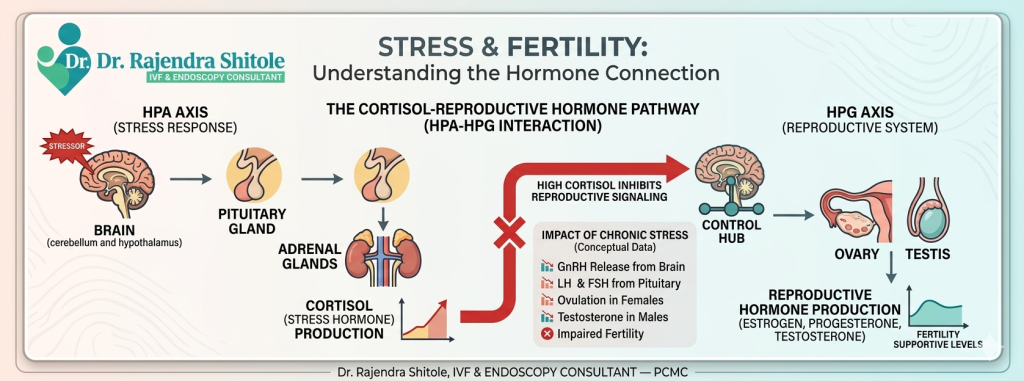
Chronic stress raises cortisol, which suppresses GnRH and disrupts the hormonal cascade needed for ovulation.
Stress alone rarely causes clinical infertility, but it worsens existing hormonal imbalances and reduces IVF success rates.
Male stress lowers testosterone and sperm count — infertility is a couple’s issue, not just a woman’s.
PCMC’s demanding IT and corporate work culture creates chronic stress patterns that affect fertility in both partners.
Evidence-based stress management — yoga, CBT, couples counselling — can improve IVF outcomes (Industry estimate).
Dr. Shitole’s PCMC clinic includes dedicated fertility counselling alongside clinical treatment.
Does Stress Affect Fertility in PCMC Couples?
Stress and infertility in PCMC is a connection many couples sense but struggle to confirm. The honest answer is nuanced: chronic psychological stress does not directly cause infertility the way blocked tubes or azoospermia does. But it creates a hormonal environment that makes conception harder and fertility treatment less effective. For couples already dealing with a fertility diagnosis, added stress compounds the problem.
Dr. Rajendra Shitole — IVF and fertility specialist in PCMC — shares the clinical evidence on stress and fertility, and practical steps PCMC couples can take to support their mental and reproductive health together.
QUICK FACTS
Cortisol (stress hormone): Suppresses GnRH when chronically elevated
IVF success rate reduction with high stress levels: Up to 20 percent (Industry estimate)
Prevalence of anxiety in infertile women in India: Approx. 40 percent (Industry estimate)
Male stress and sperm count: Chronic stress reduces testosterone and sperm production
Yoga’s effect on IVF outcomes: Associated with improved success in controlled studies (PubMed)
Counselling availability at Dr. Shitole’s PCMC clinic: Yes, included in treatment plan with full Coverage of all services
PCMC Stress and Fertility Statistics 2025-2026
| Metric | Data Point | Source |
| Infertile women with anxiety or depression | Approx. 40 percent | Industry estimate |
| Stress hormone (cortisol) and ovulation disruption | Documented clinical association | PubMed 2021 |
| IVF outcomes in high-stress patients | Up to 20 percent lower success rate | Industry estimate |
| Male stress impact on sperm count | Significant negative correlation | ICMR 2024 |
| Couples reporting infertility-related relationship strain | Over 60 percent | Industry estimate |
| Yoga and mindfulness benefit on IVF outcomes | Associated improvement in studies | PubMed 2022 |
| Counselling benefit in fertility treatment | Improves treatment adherence and outcomes | Industry estimate |
How Does Stress Affect the Female Reproductive System?
Stress activates the hypothalamic-pituitary-adrenal (HPA) axis, raising cortisol levels. Chronically elevated cortisol suppresses gonadotropin-releasing hormone (GnRH), which controls the entire reproductive hormonal cascade — FSH, LH, oestrogen and progesterone. The result is irregular cycles, delayed or absent ovulation, and reduced endometrial receptivity.
According to PubMed-published research (2021), elevated alpha-amylase — a salivary biomarker of stress — is associated with a significantly lower probability of conception. This is one of the clearest biological demonstrations that psychological state and fertility are not separate systems.
Women-Specific Stress Patterns in PCMC
Many women in Pimpri-Chinchwad’s IT corridor — particularly in Hinjewadi and Wakad — work in high-pressure roles with late hours. The added social pressure from family around conception timelines compounds clinical stress. Dr. Shitole’s clinic has a dedicated female counsellor available for patients navigating infertility alongside a demanding career.
Hormonal disruption is worsened by sleep deprivation — a common outcome of chronic work stress. Melatonin, the sleep hormone, plays a direct role in protecting egg quality. Disrupted sleep patterns during IVF stimulation can affect follicular development and oocyte quality.
How Does Stress Affect Male Fertility?
Male infertility is responsible for 40 to 50 percent of all infertility cases (ICMR 2024), yet men rarely discuss the emotional toll of infertility. Psychological stress directly suppresses testosterone production by disrupting the hypothalamic-pituitary-gonadal axis. Lower testosterone means reduced sperm production, motility and quality.
Oxidative stress — a byproduct of chronic psychological stress — damages sperm DNA. High sperm DNA fragmentation reduces fertilisation rates even with ICSI and increases miscarriage risk. Dr. Shitole recommends a sperm DNA fragmentation test for male partners who have experienced prolonged stress or whose semen parameters have changed unexpectedly.
Stress Management Techniques That Help Fertility in PCMC
Which stress management approaches have clinical evidence behind them for fertility?
| Technique | Evidence Level | How It Helps Fertility |
| Yoga and pranayama | Good — PubMed 2022 | Reduces cortisol, improves HPA balance |
| Cognitive Behavioural Therapy (CBT) | Strong — PubMed | Reduces anxiety, improves IVF adherence |
| Couples counselling | Moderate | Reduces relationship strain, improves communication |
| Mindfulness meditation | Moderate — PubMed | Lowers cortisol and oxidative stress markers |
| Moderate aerobic exercise | Good | Regulates cortisol and supports hormonal balance |
| Sleep hygiene (7 to 9 hours) | Strong | Supports melatonin and testosterone production |
| Reducing caffeine intake | Moderate | Caffeine elevates cortisol — reducing helps hormonal stability |
A Real Scenario — Stress and IVF in PCMC
A 34-year-old woman from Wakad — an IT project manager working 12-hour shifts — came to Dr. Shitole’s clinic after two failed IUI cycles. Her clinical parameters were borderline normal. During her consultation, she disclosed significant work-related anxiety and sleep disruption. Dr. Shitole referred her to the clinic’s fertility counsellor alongside her IVF protocol. She practised yoga three times a week and took one month of stress leave before her IVF cycle. Her third cycle — her first IVF attempt — was successful.
We cannot attribute that success solely to stress reduction. But clinical experience and growing evidence suggest that mental wellbeing is a genuine component of fertility outcomes.
Stress, Fertility and the Indian Family Context in PCMC
In Indian families, infertility carries a social weight that few other medical conditions do. The pressure to conceive — from parents, in-laws and extended family — can create a toxic stress cycle that worsens outcomes. Day is not just a celebration for PCMC couples; for many, it’s a reminder of an unmet hope.
Dr. Shitole’s clinic treats every couple as a unit. Both partners receive counselling, both get tested and both are included in the treatment plan. The emotional dimension of infertility is taken as seriously as the clinical one.
Women-specific note: Hormonal changes across the menstrual cycle interact with stress responses. Stress in the luteal phase (post-ovulation) is particularly associated with implantation failure. Targeted relaxation practices in this phase may support implantation outcomes.
Frequently Asked Questions
Q: Can stress alone cause infertility in a clinically healthy person?
In most cases, no. Stress does not directly block the fallopian tubes or stop sperm production. However, chronic stress disrupts the hormonal cascade required for ovulation and sperm production, and it reduces IVF success rates by up to 20 percent (Industry estimate). Stress is a contributing factor, not a standalone cause.
Q: Should I delay IVF if I’m very stressed right now?
Not necessarily. Discuss your stress levels honestly with Dr. Shitole. In some cases, adding counselling support alongside IVF is more effective than delaying treatment. In others, a short stress management period before starting may be recommended. Each case is individual.
Q: Does yoga actually help with IVF outcomes?
Multiple PubMed-published studies associate regular yoga and mindfulness practice with improved IVF outcomes, including better embryo quality and higher implantation rates. The mechanism is likely cortisol reduction and improved HPA-axis balance. Yoga is not a replacement for clinical treatment but a supportive practice.
Q: Is counselling available at Dr. Shitole’s PCMC clinic?
Yes. Dr. Shitole’s clinic at D.Y. Patil Hospital, Pimpri-Chinchwad includes dedicated fertility counselling for individuals and couples as part of the treatment programme. Counselling sessions are available in Marathi, Hindi and English.
Q: My husband is very stressed about infertility but won’t discuss it. What should I do?
Male emotional responses to infertility are often internalised. Dr. Shitole’s team is experienced in engaging male partners constructively in consultations. Many men find it easier to discuss concerns in a clinical setting rather than at home. Encourage your husband to attend the consultation together.
Q: Can antidepressants affect fertility or IVF outcomes?
Some antidepressants can affect prolactin levels and libido. If you’re on medication for anxiety or depression, inform Dr. Shitole before starting IVF. Most medications can be safely continued or adjusted without disrupting treatment. Never stop prescribed medication without consulting your doctor.
Conclusion
Stress and infertility in PCMC are connected — not in a direct cause-and-effect way, but through a web of hormonal, behavioural and psychological pathways that matter clinically. The most important thing PCMC couples can do this Day is treat their mental health as part of their fertility health.
Dr. Rajendra Shitole at D.Y. Patil Hospital, Pimpri-Chinchwad offers comprehensive fertility care that addresses both the clinical and emotional dimensions of infertility. You don’t have to navigate this alone.
Book a couples consultation this Year at drrajendrashitoleivfdoctor
Fertility treatment is not just science. It’s also about being seen, supported and cared for as a whole person — not just a set of test results. Dr. Shitole’s team is here for all of it.

Dr. Rajendra Shitole
Dr. Rajendra Shitole, Best IVF & Fertility Specialist Centre in Kharadi, Pune .He is highly skilled Gynaecologist, Fertility Consultant, and Laparoscopic & Robotic Surgeon with over 11 years of experience dedicated to women’s health and reproductive care. His mission is to help childless couples fulfill their dream of parenthood through compassionate care and advanced medical expertise.
He has successfully managed numerous complex cases of Infertility, Fibroids, PCOS, Adenomyosis, Endometriosis, and Male Factor Infertility.