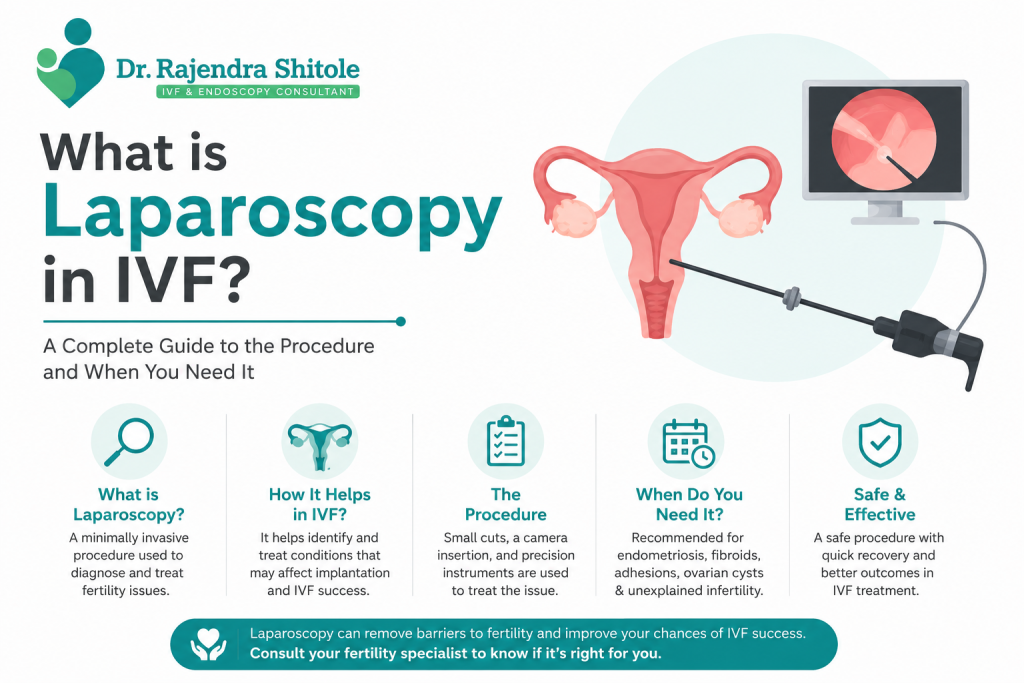
Laparoscopy in IVF is a minimally invasive surgery that uses a thin camera through a small abdominal incision to examine the uterus, ovaries and fallopian tubes. It helps diagnose or correct conditions such as endometriosis, blocked tubes and fibroids that may affect IVF success and is recommended selectively by your fertility specialist.
Key Takeaways
- Laparoscopy is a minimally invasive surgical procedure used to look inside the pelvis and abdomen through small incisions
- It is not a fertility treatment on its own; it is a diagnostic and, where needed, corrective step that can support IVF outcomes
- Common reasons include suspected endometriosis, blocked fallopian tubes, fibroids, ovarian cysts and pelvic adhesions
- Not every IVF patient needs laparoscopy; your fertility specialist will recommend it based on your history, scans and previous cycles
Recovery is generally quicker than open surgery, with most patients resuming light activity within a few days
Quick Facts
- Laparoscopy is typically performed under general anaesthesia as a day care or short stay procedure
- It uses a few small incisions of around 5 to 10 millimetres rather than one large surgical cut
- It can be diagnostic (to look and confirm) or operative (to also treat what is found) in the same sitting
- Recovery for a diagnostic procedure is usually faster than for an operative one where a condition was also treated
General reproductive health information for India is available through the National Health Portal at nhp.gov.in
| Aspect | Typical Detail | Source |
| Type of anaesthesia | General anaesthesia, day care or short stay | Industry estimate |
| Number of incisions | Usually 2 to 4 small incisions | Industry estimate |
| Procedure duration | 30 minutes to about 2 hours depending on findings | Industry estimate |
| Typical recovery for light activity | 3 to 7 days | Industry estimate |
| Gap before starting IVF stimulation | Decided case by case by your fertility specialist | Industry estimate |
Understanding Laparoscopy: A Minimally Invasive Diagnostic and Surgical Tool
Laparoscopy is a surgical technique that allows a doctor to look inside the abdomen and pelvis without making a large cut. A thin tube fitted with a camera, called a laparoscope, is passed through a small incision near the navel. The camera sends a magnified, real time image of the uterus, ovaries, fallopian tubes and surrounding structures to a monitor in the operating room.
In fertility care, laparoscopy serves two purposes. As a diagnostic tool, it lets your fertility specialist directly see conditions that scans and blood tests can suggest but not always confirm, such as endometriosis or scar tissue. As a therapeutic tool, small instruments can be passed through additional tiny incisions during the same procedure to treat what is found, for example removing endometriosis deposits, clearing adhesions or excising a cyst.
It is worth being clear about what laparoscopy is not. It is not a substitute for IVF and does not by itself achieve a pregnancy. Dr. Rajendra Shitole at IRSA Fertility explains it to patients as a step that clears the path, so that when IVF or other fertility treatment follows, the uterus and pelvis are in the best possible condition for it to succeed.
Why Laparoscopy Is Recommended Before or During IVF Treatment
Not every patient starting IVF needs laparoscopy. It is generally considered when there is a specific reason to look more closely inside the pelvis rather than as a routine step for every cycle.
| Reason for Recommendation | What It Helps Clarify |
| Suspected endometriosis on ultrasound or symptoms | Confirms presence, location and severity of endometriosis deposits |
| History of pelvic pain or painful periods | Checks for adhesions, cysts or inflammation affecting the pelvis |
| Blocked or damaged fallopian tubes on HSG | Confirms tubal status and assesses whether repair is possible |
| Fibroids affecting the uterine cavity | Determines size, location and whether removal may help implantation |
| Unexplained infertility after initial workup | Looks for pelvic factors not visible on scans alone |
| Previous failed IVF cycles without a clear reason | Checks for a missed pelvic factor before the next attempt |
Your fertility specialist will weigh these findings against your age, ovarian reserve and how urgently treatment is needed, since laparoscopy adds a step and a recovery period before IVF stimulation can begin.
Conditions Laparoscopy Can Detect and Treat
Laparoscopy is often used to investigate and manage a defined set of conditions that are known to affect fertility.
| Condition | How Laparoscopy Helps |
| Endometriosis | Confirms diagnosis and allows removal or ablation of deposits in the same sitting |
| Blocked fallopian tubes | Confirms blockage and, in select cases, allows tubal repair |
| Ovarian cysts | Allows removal of cysts while preserving healthy ovarian tissue where possible |
| Pelvic adhesions | Adhesions from past surgery or infection can be released to restore normal anatomy |
| Uterine fibroids (subserosal or intramural) | Certain fibroids can be removed laparoscopically depending on size and position |
| Ectopic pregnancy (in an emergency setting) | Allows prompt surgical management when required |
Diagnostic Laparoscopy vs Operative Laparoscopy vs Hysteroscopy
These three terms are often used together and can be confusing. Each looks at a different part of the reproductive system or serves a different purpose.
| Procedure | What It Examines | Purpose |
| Diagnostic laparoscopy | Outside of the uterus: ovaries, tubes, pelvic cavity | Confirms findings without treating them in the same sitting |
| Operative laparoscopy | Same area as diagnostic laparoscopy | Diagnoses and treats findings such as endometriosis or cysts together |
| Hysteroscopy | Inside the uterine cavity | Examines and treats issues inside the uterus, such as polyps or a septum |
Many fertility specialists, including Dr. Rajendra Shitole, combine laparoscopy and hysteroscopy in a single sitting when both the pelvis and the uterine cavity need to be assessed, so the patient goes through one anaesthesia and one recovery period rather than two separate procedures.
How Laparoscopy Is Performed: Step by Step
- Pre-procedure assessment: blood tests, fitness for anaesthesia and a discussion of what will be checked or treated
- Anaesthesia: the procedure is done under general anaesthesia, so the patient is asleep and feels nothing during it
- Creating access: carbon dioxide gas gently expands the abdomen to create working space. A small incision near the navel allows the laparoscope to be inserted
- Examination: the surgeon examines the uterus, ovaries, tubes and pelvic lining on the monitor
- Treatment, if needed: additional small incisions allow fine instruments to remove endometriosis, cysts or adhesions found during the examination
- Closure: the small incisions are closed with dissolvable stitches or adhesive strips, leaving minimal scarring
The entire procedure typically takes between 30 minutes and around two hours, depending on whether it is purely diagnostic or whether treatment is also carried out.
Laparoscopy’s Place in the IVF Timeline
| Stage | What Happens |
| Initial fertility workup | Scans, blood tests and history raise a possible pelvic concern |
| Laparoscopy (if advised) | Confirms and, where suitable, treats the finding |
| Recovery period | A few days to a few weeks depending on what was done, decided by your specialist |
| IVF stimulation begins | Once your fertility specialist confirms you are ready to proceed |
The gap between laparoscopy and starting an IVF cycle varies from patient to patient. A purely diagnostic procedure may allow IVF to begin sooner, while more involved treatment, such as extensive endometriosis removal, may call for a longer recovery window to let the pelvis heal properly.
Recovery After Laparoscopy
Because laparoscopy uses small incisions rather than one large cut, recovery is generally quicker and less uncomfortable than open abdominal surgery. Most patients go home the same day or after one night in hospital, depending on what was done.
In the first few days, mild abdominal discomfort, bloating and shoulder tip pain from the gas used during the procedure are common and usually settle on their own or with simple pain relief prescribed by your doctor. Light walking is encouraged soon after the procedure to support circulation, while heavy lifting, strenuous exercise and driving are best avoided for the period your surgeon advises. Most patients return to light desk based work within a week, though this varies with the extent of the procedure.
Follow the specific recovery instructions given at IRSA Fertility rather than general timelines, since these depend on exactly what was found and treated during your procedure.
Risks and Complications of Laparoscopy
Laparoscopy is considered a safe procedure with a long track record in gynaecological and fertility care, though like any surgery under anaesthesia it carries some risk. Possible complications include infection at the incision site, bleeding, injury to nearby organs, or reaction to anaesthesia, all of which are uncommon in experienced hands. Your fertility specialist will discuss your individual risk profile before the procedure and answer any specific concerns you have.
Who Needs Laparoscopy Before IVF and Who Can Skip It
Laparoscopy is not recommended for every patient starting IVF. Many patients with unexplained infertility, male factor infertility or ovulation related concerns proceed directly to IVF without needing this additional step. It becomes relevant when there is a specific clinical reason, such as symptoms or scan findings suggestive of endometriosis, tubal disease or significant pelvic pathology, or when previous IVF cycles have not been successful without a clear explanation.
The decision is individual. Dr. Rajendra Shitole reviews each patient’s history, previous scans, age and ovarian reserve before advising whether laparoscopy would meaningfully change the treatment plan or whether proceeding straight to IVF is the better option.
Common Myths About Laparoscopy and Fertility
| Myth | Fact |
| Laparoscopy itself causes pregnancy | It is a diagnostic or corrective procedure, not a fertility treatment on its own |
| Every IVF patient must undergo laparoscopy first | It is advised selectively, based on individual history and findings |
| Recovery always takes several weeks | Diagnostic laparoscopy recovery is often just a few days; timelines vary with what was treated |
| Laparoscopy always leaves large visible scars | Incisions are small (usually just a few millimetres) and heal with minimal scarring over time |
| Laparoscopy guarantees IVF success afterward | It can improve the chances in select cases, but does not guarantee an outcome |
Laparoscopy and Fertility Care in Pune
Patients consulting Dr. Rajendra Shitole at IRSA Fertility in Kharadi often ask practical questions about planning around the procedure. Since laparoscopy requires general anaesthesia and a short hospital stay, patients travelling from areas such as Wagholi, Viman Nagar or Hadapsar are advised to arrange a companion for the day and avoid driving themselves home. Pune’s traffic patterns, particularly along the Kharadi and Wagholi stretch during peak hours, are worth factoring into the discharge and follow up visit timing. Patients on hormone medication as part of a combined workup should also plan for adequate hydration, especially during Pune’s warmer months, since this can support a smoother recovery.
Frequently Asked Questions
1. Is laparoscopy painful?
The procedure itself is done under general anaesthesia, so you feel nothing during it. Mild discomfort, bloating or shoulder pain afterward is common and usually manageable with the pain relief your doctor prescribes.
2. How long does laparoscopy recovery take before starting IVF?
This varies with what was found and treated. A diagnostic procedure may allow IVF to begin sooner, while more extensive treatment, such as endometriosis removal, often needs a longer recovery window decided by your fertility specialist.
3. Does laparoscopy affect ovarian reserve?
When performed carefully, laparoscopy aims to preserve healthy ovarian tissue. Your specialist will discuss any specific concerns related to your ovarian reserve before the procedure.
Can laparoscopy be combined with hysteroscopy?
Yes, many fertility specialists perform both in a single sitting when both the pelvis and the uterine cavity need to be examined, reducing the need for a second anaesthesia and recovery period.
Is laparoscopy necessary for every IVF patient?
No. It is recommended selectively, based on symptoms, scan findings or previous treatment history, not as a routine step for everyone starting IVF.
How soon can I go home after laparoscopy?
Many patients go home the same day or after one night in hospital, depending on the extent of the procedure and how they respond to anaesthesia.
What should I ask my fertility specialist before laparoscopy?
Useful questions include why the procedure is being advised in your specific case, what it may find or treat, how it could change your IVF plan and how long recovery is expected to take before stimulation can begin.

Dr. Rajendra Shitole
Dr. Rajendra Shitole, Best IVF & Fertility Specialist Centre in Kharadi, Pune .He is highly skilled Gynaecologist, Fertility Consultant, and Laparoscopic & Robotic Surgeon with over 11 years of experience dedicated to women’s health and reproductive care. His mission is to help childless couples fulfill their dream of parenthood through compassionate care and advanced medical expertise.
He has successfully managed numerous complex cases of Infertility, Fibroids, PCOS, Adenomyosis, Endometriosis, and Male Factor Infertility.