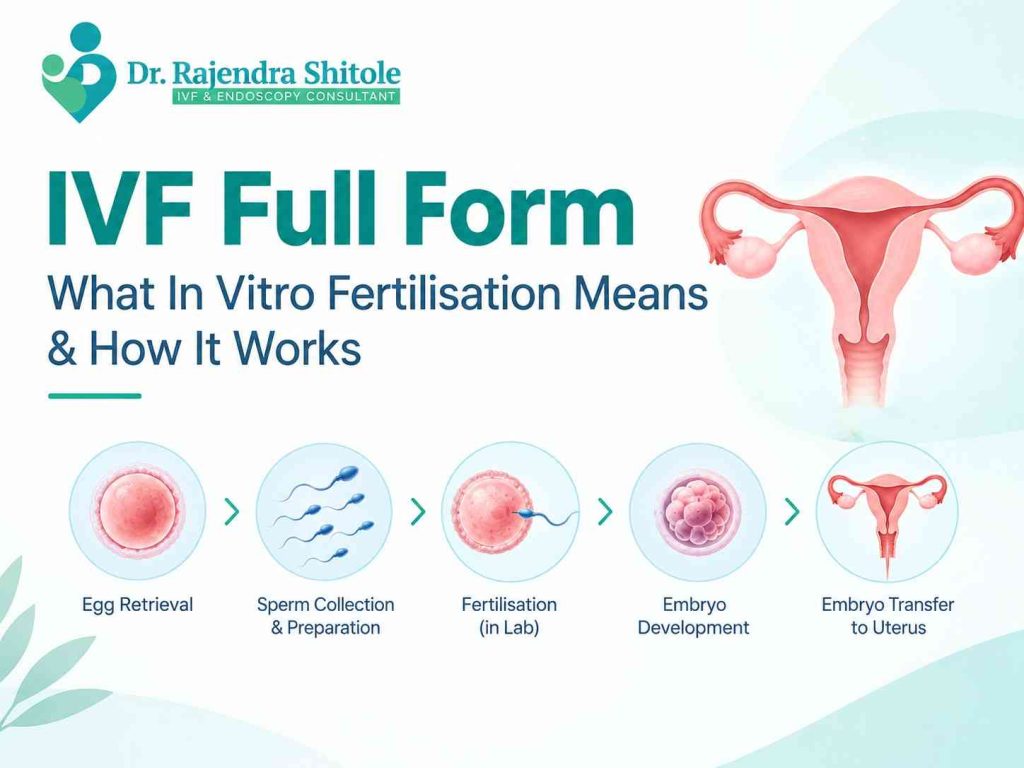
The IVF full form is In Vitro Fertilisation. It is a fertility treatment in which eggs are collected from the ovaries and fertilised with sperm in a laboratory dish. The resulting embryo is then placed in the woman’s uterus to help a couple achieve a healthy pregnancy.
KEY TAKEAWAYS
- In India, IVF is regulated under the Assisted Reproductive Technology (Regulation) Act, 2021.
- The IVF full form is In Vitro Fertilisation. ‘In vitro’ is Latin for ‘in glass’, meaning fertilisation happens in a laboratory dish rather than inside the body.
- IVF is a step-by-step treatment, not a single procedure: stimulation, egg retrieval, lab fertilisation, embryo culture and embryo transfer.
- Age is the strongest single factor in IVF outcomes, especially the woman’s age and egg quality.
- IVF is not always the first option. Many couples conceive with simpler steps such as ovulation induction or IUI.
QUICK FACTS
- Full form: In Vitro Fertilisation
- Meaning of ‘in vitro’: In glass (Latin), that is, outside the body in a lab dish
- Opposite term: In vivo, meaning inside the living body
- World’s first IVF baby: Louise Brown, born 25 July 1978 in the UK
- India’s first IVF baby: Kanupriya (Durga) Agarwal, born 3 October 1978 in Kolkata
- Typical cycle length: About 4 to 6 weeks from the start of stimulation to the pregnancy test
- Governing law in India: ART (Regulation) Act, 2021
What Is the Full Form of IVF?
The IVF full form is In Vitro Fertilisation. Each letter carries part of the meaning:
- I – In: inside
- V – Vitro: from the Latin ‘vitrum’, meaning glass
- F – Fertilisation: the joining of an egg and a sperm to form an embryo
Put together, in vitro fertilisation means ‘fertilisation in glass’. The term goes back to the glass dishes and test tubes used in early laboratory work. That is also why IVF babies were once called ‘test tube babies’, even though modern labs use specialised culture dishes rather than test tubes.
You may see two spellings: ‘fertilisation’ (Indian and British English) and ‘fertilization’ (American English). Both refer to the same treatment.
What Does IVF Mean in Simple Words?
In natural conception, the egg and sperm meet inside the fallopian tube. In IVF, that meeting is moved to a controlled laboratory. Doctors collect mature eggs from the woman’s ovaries, an embryologist combines them with sperm, and the healthiest embryo is later placed in the uterus.
So when someone asks for the full form of IVF, the short answer is In Vitro Fertilisation. The practical answer is this: IVF does outside the body the one step that, for some reason, is not happening inside it.
Why Is IVF Called ‘In Vitro’?
Medical science uses two Latin terms to say where something happens:
- In vitro: in a lab, outside a living body (in glass)
- In vivo: inside a living body
Natural conception is in vivo. IVF is in vitro because the egg and sperm meet in a dish. Once the embryo is transferred to the uterus, implantation and pregnancy carry on in the body, just as they would after natural conception.
Who May Need IVF?
IVF is usually advised when simpler treatments are unlikely to work or have not worked. Common reasons include:
- Blocked or damaged fallopian tubes, where the egg and sperm cannot meet naturally
- Male factor infertility, such as low sperm count or poor motility, often treated with ICSI alongside IVF
- Endometriosis, particularly moderate to severe disease
- PCOS that has not responded to ovulation induction
- Reduced ovarian reserve or advancing maternal age
- Unexplained infertility after a year or more of trying
- Repeated failed IUI cycles
- Fertility preservation, such as egg or embryo freezing before cancer treatment
A general rule many specialists follow: if the woman is under 35 and the couple has tried for 12 months without success, it is time for a fertility evaluation. Over 35, that window shortens to about 6 months.
How Does IVF Work? The Step-by-Step Process
Step 1: Initial Evaluation
Both partners are assessed. Typical tests include AMH and other hormone levels, a pelvic ultrasound with antral follicle count, a semen analysis and checks of the uterus and tubes.
Step 2: Ovarian Stimulation
Daily hormone injections for about 8 to 14 days encourage the ovaries to mature several eggs instead of one. Follicle growth is tracked with ultrasound scans and blood tests.
Step 3: Trigger Injection and Egg Retrieval
Once the follicles reach the right size, a trigger injection completes egg maturation. Eggs are collected about 34 to 36 hours later through a thin needle guided by ultrasound, usually under short sedation. Most women go home the same day.
Step 4: Fertilisation in the Laboratory
On the same day, the eggs are combined with sperm. In conventional IVF, sperm and eggs are placed together in a dish. In ICSI, the embryologist injects a single sperm directly into each egg, which helps when sperm quality is low.
Step 5: Embryo Culture
Fertilised eggs grow in an incubator for 3 to 5 days. A Day 5 embryo is called a blastocyst. The embryologist grades embryos to choose the strongest one for transfer.
Step 6: Embryo Transfer
A soft catheter places the selected embryo into the uterus. The procedure is usually painless and takes only a few minutes. Good-quality spare embryos can be frozen for a later frozen embryo transfer.
Step 7: Pregnancy Test
A blood test for beta hCG is done about 10 to 14 days after the transfer. This wait is often the hardest part emotionally, and good clinics make sure couples have someone to call during it.
IVF vs IUI vs ICSI: How Are They Different?
Once the IVF full form is clear, the next question is usually how it differs from IUI and ICSI. These three terms often get mixed up. Here is how they compare:
- IUI (Intrauterine Insemination): Washed sperm is placed directly in the uterus around ovulation. Fertilisation still happens inside the body. Less invasive and lower in cost, suited to mild fertility issues.
- IVF (In Vitro Fertilisation): Eggs are collected and fertilised with sperm in a lab dish. The embryo is then transferred to the uterus.
- ICSI (Intracytoplasmic Sperm Injection): A type of IVF in which one sperm is injected into each egg. Mainly used for male factor infertility or after poor fertilisation in a previous IVF cycle.
You can read more on each option on the pages for IUI treatment in pune and ICSI treatment in pune
What Affects IVF Success?
Knowing the IVF full form tells you what the treatment is, but not how likely it is to work. No honest specialist can promise a result. Outcomes depend on several factors:
- Woman’s age: the single strongest factor, because egg quality and number fall with age
- Ovarian reserve: reflected in AMH and antral follicle count
- Sperm quality: count, motility and DNA integrity
- Embryo quality: blastocysts tend to implant better than earlier-stage embryos
- Uterine health: fibroids, polyps, adhesions or a thin lining can affect implantation
- Lifestyle: smoking, high BMI and uncontrolled thyroid or blood sugar levels lower the odds
- Lab standards: air quality, incubator control and embryologist experience
Ask any clinic for live birth rates, not just pregnancy rates, and ask for figures in your own age group.
What IVF Cannot Do
IVF treatments in pune works well for many couples, but it has limits. Being clear about them helps couples plan:
- IVF cannot reverse egg ageing. It can make better use of the eggs available, but it cannot create better-quality eggs.
- One cycle does not guarantee a baby. Many couples need more than one attempt.
- IVF does not fix uterine problems on its own. Fibroids, polyps or septum may need laparoscopic or hysteroscopic correction first.
- IVF cannot choose a baby’s sex. Sex selection is illegal in India under the PCPNDT Act.
Risks and Side Effects of IVF
IVF is considered safe in experienced hands, but couples should know about possible risks:
- Ovarian hyperstimulation syndrome (OHSS): swollen, painful ovaries due to the stimulation drugs. Severe OHSS is uncommon with modern protocols, but needs urgent care.
- Multiple pregnancy: higher when more than one embryo is transferred. Single embryo transfer reduces this risk.
- Ectopic pregnancy: an embryo implanting outside the uterus, which is rare but possible
- Procedure-related effects: mild cramping, bloating or spotting after retrieval
- Emotional strain: stress, anxiety and low mood are common and deserve attention
Seek medical help urgently if you notice severe abdominal pain, rapid weight gain, breathlessness, reduced urine output or heavy bleeding during or after an IVF cycle.
How Much Does IVF Cost in India?
Many people who search for the IVF full form also want to know the cost. IVF cost varies from clinic to clinic and from couple to couple. The main factors are:
- Stimulation drugs: the dose and duration depend on age and ovarian reserve
- Lab technique: conventional IVF or ICSI
- Add-ons: blastocyst culture, embryo freezing, genetic testing (PGT) or donor eggs or sperm
- Number of cycles: some couples need a second fresh or frozen transfer
At IRSA Fertility in Kharadi, an IVF cycle typically ranges from about Rs 1 lakh to Rs 2.5 lakh, and a full cost breakdown is shared after the first consultation. Ask for a written estimate that lists what is and is not included.
Is IVF Legal and Regulated in India?
Yes. In India, IVF clinics and ART banks must register under the Assisted Reproductive Technology (Regulation) Act, 2021. The Act sets eligibility ages, requires written consent from both partners, limits the number of embryos that can be transferred and bans sex selection. National guidelines from the Indian Council of Medical Research (ICMR) also apply. When choosing a clinic, it is reasonable to ask for its ART registration details.
A Short History of IVF
In vitro fertilisation entered everyday language after a few landmark births:
- 1978, UK: Louise Brown becomes the world’s first baby born through IVF.
- 1978, Kolkata: Dr. Subhas Mukhopadhyay’s work leads to the birth of Kanupriya (Durga) Agarwal, India’s first IVF baby.
- 1986, Mumbai: Harsha Chawda becomes India’s first scientifically documented IVF baby, born under an ICMR-supported programme.
- 1992: ICSI is introduced, changing care for male factor infertility.
- 2021: India passes the ART (Regulation) Act to bring IVF clinics under a legal framework.
10. DOCTOR BIO (LOCAL GEO SECTION)
Meet Dr. Rajendra Shitole, IVF Doctor in Pune
Dr. Rajendra Shitole is an IVF doctor in Pune with more than 11 years of experience in infertility care, gynaecology and minimally invasive surgery. He consults at IRSA Fertility – IVF & Endoscopy Clinic in Kharadi, where he personally manages diagnosis and treatment for each couple.
Qualifications and Training
- MBBS: ACPM Medical College, Dhule
- DGO (Obstetrics & Gynaecology): BJ Govt. Medical College & Sassoon General Hospital, Pune
- DNB (Obstetrics & Gynaecology): Sanjay Gandhi Memorial Hospital, New Delhi
- Fellowship in IVF & Endoscopy: Ruby Hall Clinic, Pune
- Diploma & Fellowship in Minimal Access Surgery: World Laparoscopy Hospital, Gurgaon, where he topped the national and international fellows
- Certification in Robotic Surgery: World Laparoscopy Hospital, Gurgaon and Amrita Institute of Medical Sciences, Cochin
- Memberships and qualifications listed: DMAS, FMAS, MNAMS
Areas of Care
- IVF, ICSI and IUI
- Male and female infertility evaluation
- PCOS, endometriosis, adenomyosis and fibroids
- Laparoscopic, hysteroscopic and robotic surgery
- Fertility preservation, including egg freezing and sperm banking
- High-risk pregnancy care after fertility treatment
Because he is also a trained laparoscopic and robotic surgeon, Dr. Shitole can treat problems such as blocked tubes, fibroids or endometriosis before IVF without referring couples elsewhere. For couples searching for an IVF doctor in Pune, this means diagnosis, surgery and IVF can be handled by the same specialist.
Clinic Details
- Clinic: IRSA Fertility – IVF & Endoscopy Clinic
- Address: Office No. 205/206, 2nd Floor, Kulscapes, Velstand, Opp. Reliance Mall, Above Apollo Clinic, Kharadi, Pune, Maharashtra 411014
- Phone / WhatsApp: +91 82084 22881
- Timings: 9:00 am to 8:30 pm
- Easy to reach from: Viman Nagar, Wagholi, Hadapsar, Magarpatta, Kalyani Nagar, Yerawada and Kharadi IT Park
What is the full form of IVF?
The full form of IVF is In Vitro Fertilisation. It means fertilisation of an egg by sperm outside the body, in a laboratory dish, after which the embryo is placed in the uterus.
What is the IVF full form in medical terms?
In medical terms, the IVF full form is In Vitro Fertilisation, a type of Assisted Reproductive Technology (ART). It covers ovarian stimulation, egg retrieval, lab fertilisation, embryo culture and embryo transfer.
Is IVF the same as a test tube baby?
Yes. ‘Test tube baby’ is the popular name for a baby conceived through IVF. In practice, fertilisation happens in a culture dish, not a test tube, and the pregnancy develops normally in the mother’s uterus.
Is IVF painful?
Most women describe IVF as uncomfortable rather than painful. Injections cause brief pricks, egg retrieval is done under short sedation and embryo transfer usually feels like a routine pelvic examination.
How long does one IVF cycle take?
One IVF cycle usually takes about 4 to 6 weeks, including around 2 weeks of stimulation, egg retrieval, 3 to 5 days of embryo culture and about 2 weeks before the pregnancy test.
What is the right age for IVF?
IVF works better at a younger age because egg quality is higher. In India, the ART Act allows treatment for women aged 21 to 50 and men aged 21 to 55, but outcomes drop noticeably after 40.
Are IVF babies normal and healthy?
Most babies born through IVF are healthy and develop normally. Slightly higher risks seen in some studies are linked mainly to multiple pregnancies and parental age, which single embryo transfer helps reduce.
When should we see an IVF doctor in Pune?
See a fertility specialist after 12 months of trying if the woman is under 35, after 6 months if she is over 35, or sooner if there is known PCOS, endometriosis, blocked tubes or a low sperm count.
Have questions about IVF or your fertility test reports?
Call or WhatsApp +91 82084 22881 (9:00 am to 8:30 pm), or use the appointment form on the contact page. Bring any past reports, scans and semen analysis results to your first visit.

Dr. Rajendra Shitole
Dr. Rajendra Shitole, Best IVF & Fertility Specialist Centre in Kharadi, Pune .He is highly skilled Gynaecologist, Fertility Consultant, and Laparoscopic & Robotic Surgeon with over 11 years of experience dedicated to women’s health and reproductive care. His mission is to help childless couples fulfill their dream of parenthood through compassionate care and advanced medical expertise.
He has successfully managed numerous complex cases of Infertility, Fibroids, PCOS, Adenomyosis, Endometriosis, and Male Factor Infertility.