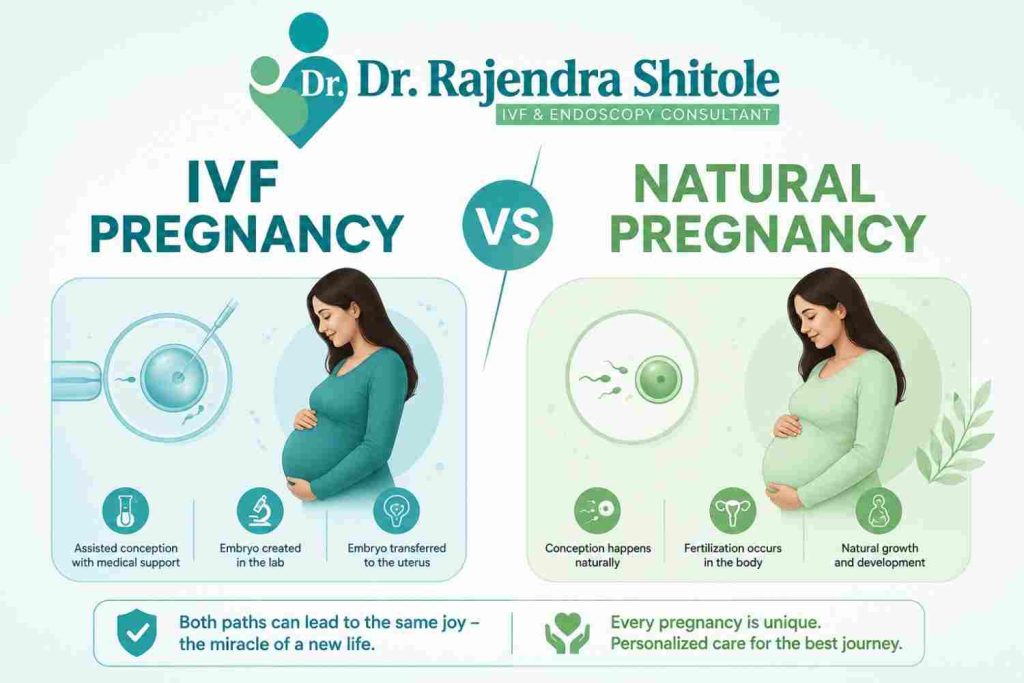
IVF Pregnancy vs Natural Pregnancy is a common question among couples who are considering fertility treatment or have recently conceived through in-vitro fertilization. Although the way conception occurs is different, an IVF pregnancy and a naturally conceived pregnancy share many similarities once implantation has occurred. IVF Doctor in Pune, Dr. Rajendra Shitole, explains that the differences are mainly related to how fertilization takes place, the need for fertility treatment and monitoring, and certain pregnancy-related considerations.
For couples considering IVF Treatment in Pune, understanding these differences can help set realistic expectations and reduce unnecessary concerns. IVF is an established fertility treatment that can help couples facing conditions such as blocked fallopian tubes, male-factor infertility, endometriosis and unexplained infertility.
IVF Pregnancy vs Natural Pregnancy: What Is the Difference?
| Factor | IVF Pregnancy | Natural Pregnancy |
|---|---|---|
| How conception occurs | Fertilization takes place in a laboratory before the embryo is transferred to the uterus. | Fertilization usually occurs naturally inside the fallopian tube. |
| Need for fertility treatment | Requires assisted reproductive treatment such as IVF. | Does not require fertility treatment in most cases. |
| Egg and sperm meeting | Egg and sperm are brought together under laboratory conditions. | Egg and sperm meet naturally within the reproductive tract. |
| Embryo transfer | A selected embryo is transferred into the uterus by a fertility specialist. | There is no medical embryo-transfer procedure. |
| Pregnancy testing | Beta-hCG blood testing is usually scheduled after embryo transfer. | Pregnancy is usually confirmed through a urine or blood pregnancy test after a missed period. |
| Early monitoring | May involve closer monitoring during the early pregnancy stage. | Routine prenatal monitoring is generally followed according to the pregnancy. |
| Pregnancy symptoms | Symptoms can include nausea, fatigue, breast tenderness and other normal pregnancy symptoms. Fertility medicines may also cause some symptoms. | Similar pregnancy symptoms may occur due to hormonal changes. |
| Hormonal support | Some patients may require progesterone or other medicines following embryo transfer. | Hormonal supplementation is generally not required unless medically indicated. |
| Multiple pregnancy | Multiple pregnancy can occur, particularly when more than one embryo is transferred. | Twins or multiples can occur naturally, but the chance is generally lower. |
| Ultrasound monitoring | Early ultrasound may be performed as part of IVF follow-up. | Ultrasound is performed according to routine prenatal care and medical requirements. |
| Delivery method | IVF does not automatically require a C-section. Delivery depends on obstetric factors. | Vaginal or cesarean delivery depends on maternal and fetal factors. |
| Baby’s development | Once pregnancy is established, fetal development follows the normal biological process. | Fetal development follows the normal biological process. |
| Pregnancy risks | Risk depends on age, health, infertility factors, singleton/multiple pregnancy and other conditions. | Risk depends on maternal health, age, pregnancy characteristics and other medical factors. |
| Doctor’s role | An IVF Specialist in Pune, Dr. Rajendra Shitole, may monitor treatment and early pregnancy closely. | An obstetrician/gynecologist provides routine pregnancy care. |
| Main advantage | Can help couples who have difficulty conceiving naturally. | Conception occurs without assisted reproductive procedures. |
Key Difference at a Glance
| IVF Pregnancy | Natural Pregnancy |
|---|---|
| Assisted conception | Natural conception |
| Fertilization occurs in a laboratory | Fertilization usually occurs in the fallopian tube |
| Embryo is transferred into the uterus | Embryo naturally travels to the uterus |
| Beta-hCG testing is scheduled after embryo transfer | Pregnancy test is usually taken after a missed period |
| May require additional early monitoring | Routine prenatal monitoring is generally followed |
IVF Pregnancy and Natural Pregnancy: What About Delivery?
Having an IVF pregnancy does not automatically mean that a woman must have a cesarean delivery. The method of conception alone does not determine the mode of delivery. The decision between vaginal birth and cesarean delivery depends on factors such as:
- Baby’s position
- Placental location
- Maternal health
- Fetal health
- Previous surgeries
- Pregnancy complications
- Progress of labour
- Obstetric indications
Does IVF Pregnancy Need More Ultrasounds?
IVF pregnancies may involve additional monitoring, particularly in early pregnancy.
Your doctor may recommend ultrasounds to assess:
- Location of the pregnancy
- Gestational sac
- Yolk sac
- Embryonic development
- Cardiac activity when appropriate
- Growth and development later in pregnancy
The exact schedule depends on the patient’s medical history and pregnancy.
Natural pregnancies can also require additional ultrasounds when there are medical concerns. Therefore, the number of scans should be individualized rather than compared directly between IVF and natural conception. An IVF pregnancy can therefore result in a vaginal birth when medically appropriate.
Are IVF Pregnancies Considered High-Risk?
- Not every IVF pregnancy should automatically be considered a high-risk pregnancy.
- However, some IVF patients may require closer monitoring because of factors associated with infertility or the circumstances surrounding conception.
- For example, some patients undergoing IVF may be older, have underlying medical conditions, have a history of pregnancy loss, or become pregnant with multiples.
- The risk profile therefore depends on the individual patient.
- A singleton IVF pregnancy in a healthy woman may progress normally, while another IVF pregnancy may require additional monitoring because of age, medical history or pregnancy-related complications.
- This is why individualized care from an IVF Doctor in Pune is important.
Consult Dr. Rajendra Shitole – IVF Specialist in Pune
IRSA Fertility – IVF & Endoscopy Clinic, Kharadi, Pune
Address: Office No. 205/206 2nd, IRSA Fertility – IVF & Endoscopy Clinic, Kul Scapes, above Apollo Clinic, Velstand, Kharadi, Pune, Maharashtra 411014
Contact: 82084 22881
Website: drrajendrashitoleivfdoctor.com

Dr. Rajendra Shitole
Dr. Rajendra Shitole, Best IVF & Fertility Specialist Centre in Kharadi, Pune .He is highly skilled Gynaecologist, Fertility Consultant, and Laparoscopic & Robotic Surgeon with over 11 years of experience dedicated to women’s health and reproductive care. His mission is to help childless couples fulfill their dream of parenthood through compassionate care and advanced medical expertise.
He has successfully managed numerous complex cases of Infertility, Fibroids, PCOS, Adenomyosis, Endometriosis, and Male Factor Infertility.