Table of contents
Fertility treatments have come a long way over time, providing couples with more choices than ever for treatment of infertility. Two terms commonly discussed when discussing assisted reproduction are in vitro fertilization (IVF) and in vivo fertilization. Both aim to help individuals conceive, however their approaches differ fundamentally in where and how fertilization occurs – understanding this difference will enable you to make informed decisions throughout your fertility journey.
What Is In Vivo Fertilization?
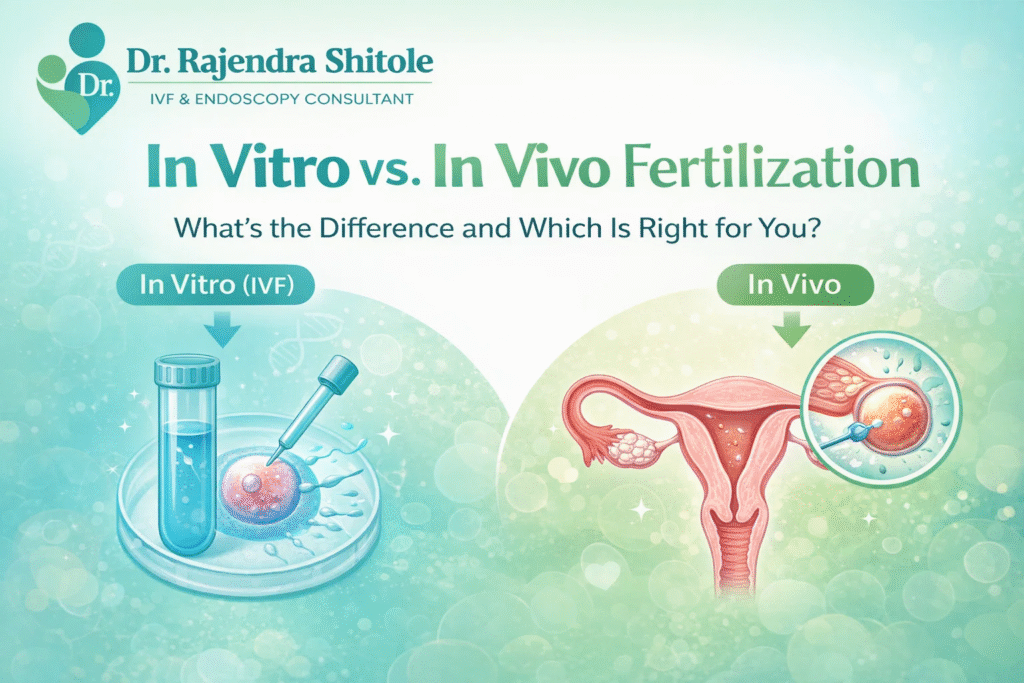
“In vivo” translates from Latin as “within the living.” IVF refers to an organic process occurring inside human bodies – particularly through fallopian tubes – where sperm cells meet and fertilize an egg through intercourse or intrauterine insemination (IUI).
- In-vitro fertilization (IVF) is the body’s natural reproductive mechanism; when couples conceive naturally, in vivo fertilization takes place during this process. Medically assisted techniques used for in vivo fertility include ICSI:
- Intrauterine Insemination (IUI): Washed and concentrated sperm are placed directly into the uterus just prior to ovulation in order to increase chances of fertilizing an egg naturally within your body.
- Ovulation Induction: Hormonal medications stimulate the ovaries to release one or more eggs, increasing chances of natural conception or IUI success.
In-vitro approaches tend to be less invasive and are often the first line of defense against mild fertility issues, including unexplained infertility, mild male factor infertility or ovulatory disorders.
In vivo approaches are generally less invasive and are often the first line of treatment for mild fertility challenges, such as unexplained infertility, mild male factor infertility, or ovulatory disorders.
What Is In Vitro Fertilization (IVF)?
Its “In vitro” refers to laboratory environments where fertilization takes place. With IVF, eggs are collected from ovaries and fertilized in an outside laboratory environment by sperm from donor eggs retrieved from outside sources before being transferred back into the uterus as an embryo. This typical IVF process typically entails:
- Ovarian Stimulation: Hormonal injections stimulate the ovaries to produce multiple mature eggs.
- Egg Retrieval: A minor surgical procedure removes mature eggs from ovary by retrieval.
- Fertilization: Eggs and sperm are combined in a laboratory dish; in severe male factor infertility cases, an intracytoplasmic Sperm Injection may be performed (ICSI — Intracytoplasmic Sperm Injection). * Embryo Culture: Fertilized embryos are monitored over three to five days to observe any development that might have taken place since conception.
- Embryo Transfer: Healthy embryos are implanted into the uterus through IVF. IVF may be recommended in cases involving blocked or damaged fallopian tubes, low sperm count/motility issues (male factor infertility) as well as advanced maternal age, Endometriosis affecting fertility or failed IUI cycles.
Genetic conditions that necessitate preimplantation genetic testing (PGT).
Key Differences at a Glance
| Feature | In Vivo Fertilization | In Vitro Fertilization (IVF) |
| Location of fertilization | Inside the body (fallopian tube) | Outside the body (laboratory) |
| Invasiveness | Low to moderate | Moderate (requires egg retrieval) |
| Success rates | Lower per cycle | Higher per cycle (40–50% in younger patients) |
| Ideal candidates | Mild fertility issues | Moderate to severe infertility |
| Cost | Lower | Higher |
| Customization | Limited | High (ICSI, PGT, frozen embryos) |
Which Option Is Right for You?
Deciding which treatment option best meets your needs depends on several factors, including the underlying cause of infertility, age, medical history and how long you have been trying. A thorough fertility evaluation including blood tests, semen analysis and ultrasound assessments should always precede any advice for treatment options; couples experiencing mild fertility issues may begin with in vivo approaches like IUI; however, couples dealing with structural or severe fertility challenges typically benefit more from IVF procedures.
Consult the Best IVF & Fertility Specialist in PCMC
Are You Struggling with Fertility Issues in Pimpri-Chinchwad? For world-class care, don’t look further. Here in Pimpri-Chinchwad, there is no shortage of outstanding care providers specializing in IVF/fertility treatments available nearby. Dr. Rajendra Shitole is widely recognized as the Best IVF & Fertility Specialist of PCMC, possessing extensive expertise both in-vitro and in vivo fertility treatments. Dr. Shitole provides comprehensive fertility services to patients across Pimpri, Chinchwad, Nigdi, Akurdi and the greater Pune region, combining advanced clinical expertise with a compassionate patient-first approach – offering customized plans tailored to each couple’s specific needs – such as IUI, IVF, ICSI or advanced genetic screening services to increase chances of successful pregnancies.

Dr. Rajendra Shitole
Dr. Rajendra Shitole, Best IVF & Fertility Specialist Centre in Kharadi, Pune .He is highly skilled Gynaecologist, Fertility Consultant, and Laparoscopic & Robotic Surgeon with over 11 years of experience dedicated to women’s health and reproductive care. His mission is to help childless couples fulfill their dream of parenthood through compassionate care and advanced medical expertise.
He has successfully managed numerous complex cases of Infertility, Fibroids, PCOS, Adenomyosis, Endometriosis, and Male Factor Infertility.