Medically reviewed by: Dr. Rajendra Shitole, MBBS, DGO, DNB (Obstetrics and Gynaecology), Fellowship in IVF and Endoscopy | Updated: 29 October 2026
Couples planning ICSI usually ask one question first: what is the ICSI pregnancy success rate? There is no single number that fits everyone. The figure changes with age, sperm quality, egg quality, embryo quality and the lab doing the work. This article explains the typical ranges and how to read them.
Key takeaways on the ICSI pregnancy success rate
- Age matters most. The ICSI pregnancy success rate falls steadily as the woman’s age rises, mainly because egg quality declines.
- Fertilisation is not pregnancy. ICSI fertilises about 70 to 85 in 100 injected eggs, but far fewer cycles end in a live birth.
- Ask which rate is quoted. Per cycle, per transfer, clinical pregnancy and live birth are four different numbers.
- ICSI is not needed by everyone. Without a male factor or an earlier fertilisation failure, routine ICSI is not shown to improve live birth.
- No figure is a promise. Every number here is an industry estimate, so your own chances need a doctor’s assessment.
What is the ICSI pregnancy success rate?
The ICSI pregnancy success rate depends mainly on the woman’s age and egg quality. As an industry estimate, live birth per cycle is about 35% under 35 years and falls to about 12% after 40. Sperm quality, embryo quality and the lab also matter. Individual results vary.
ICSI stands for intracytoplasmic sperm injection. An embryologist selects one sperm and injects it directly into one mature egg. The fertilised eggs grow into embryos in the lab, and one or two are transferred to the uterus. The ICSI pregnancy success rate measures how often this process ends in a pregnancy or a baby.
ICSI pregnancy success rate by age
Age is the strongest single factor. The figures below are industry estimates from published international clinic data. They are a general guide and not a prediction for any one patient.
- Under 35 years: roughly 44 in 100 embryo transfers lead to clinical pregnancy, and about 35 in 100 cycles end in a live birth.
- 35 to 39 years: roughly 35 in 100 transfers lead to pregnancy, and about 25 in 100 cycles end in a live birth.
- 40 years and above: roughly 21 in 100 transfers lead to pregnancy, and about 12 in 100 cycles end in a live birth.
- Above 43 years: the rate with the woman’s own eggs is often reported below 5 in 100.
Clinics in India publish a wide spread of ranges, and many do not state the data behind them. When you compare any ICSI pregnancy success rate, check the age group, the source and the year before you trust it.
ICSI pregnancy success rate and fertilisation rate: the difference
People often mix these terms up. A high fertilisation rate does not mean a high chance of pregnancy, because the embryo still has several steps to complete. Three terms explain most of the confusion:
- Fertilisation rate: the share of injected eggs that fertilise. Industry estimates put it at about 70 to 85 in 100 with ICSI.
- Clinical pregnancy rate: the share of cycles or transfers where a scan shows a pregnancy in the uterus.
- Live birth rate: the share of cycles that end with a baby born. This is the most meaningful figure, and it is always lower than the pregnancy rate.
Whenever you see an ICSI pregnancy success rate, find out whether it counts pregnancies or live births.
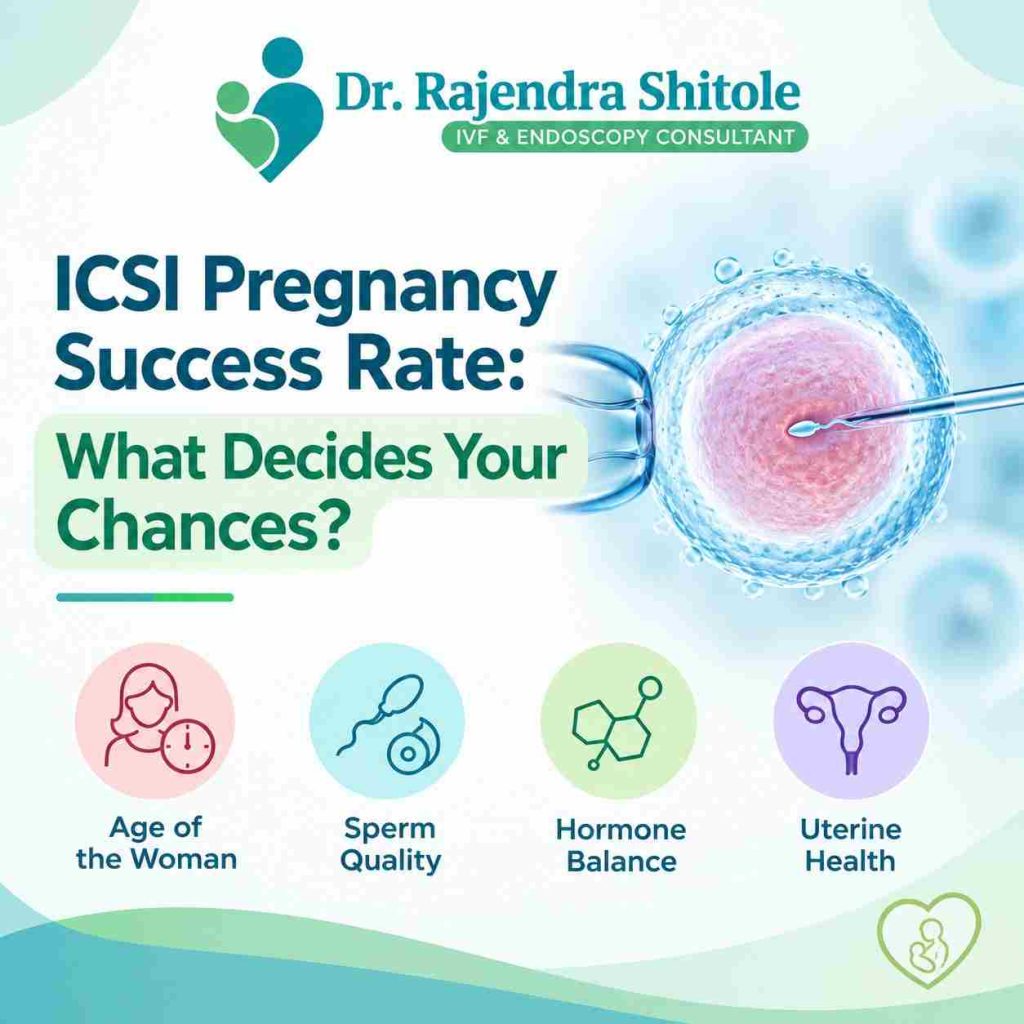
What affects the ICSI pregnancy success rate?
- Woman’s age and ovarian reserve: AMH and antral follicle count help estimate how many eggs a woman may respond with, and age influences egg quality.
- Egg maturity and quality: ICSI needs mature eggs. Poor egg quality can lower the ICSI pregnancy success rate even with healthy sperm.
- Sperm quality: count, movement, shape and DNA integrity all play a role.
- Embryo quality: embryos that grow well to day 5 or 6 implant more often.
- Uterine health: fibroids, polyps, adhesions and a thin lining can block implantation.
- Laboratory conditions: incubators, air quality and the embryologist’s skill affect embryo growth.
- Lifestyle: smoking, higher body weight and uncontrolled diabetes or thyroid problems are linked with poorer IVF and ICSI outcomes.
- Cause of infertility: the reason for the delay in conceiving changes the expected result.
Does ICSI have a higher success rate than conventional IVF?
The honest answer is that it depends on why the couple needs treatment. ICSI is very effective when sperm count, movement or shape is clearly abnormal. It also helps when conventional insemination failed to fertilise eggs in an earlier cycle.
For couples with no male factor, the evidence is different. The American Society for Reproductive Medicine reviewed this question and found no improvement in live birth with routine ICSI in unexplained infertility, low egg numbers or advanced maternal age. It does not support using ICSI on all eggs when there is no male factor or earlier fertilisation failure. This is why the ICSI pregnancy success rate should be read together with the reason ICSI was chosen. You can read how a standard cycle works on the IVF treatment page.
When do doctors recommend ICSI?
- Abnormal semen results: low count, poor movement or abnormal shape, which a male infertility evaluation can confirm.
- Surgically retrieved sperm: when sperm is collected directly from the testis or epididymis.
- Earlier fertilisation failure: when eggs did not fertilise with conventional IVF.
- Frozen eggs: eggs that were frozen earlier are often fertilised by ICSI. You can read about egg freezing under fertility preservation.
- Embryo genetic testing: some testing protocols use ICSI to avoid extra sperm affecting the result.
The full procedure, from egg retrieval to embryo transfer, is explained on the ICSI treatment page.
Questions to ask when a clinic quotes an ICSI pregnancy success rate
A figure without context can mislead. These questions make any quoted rate easier to understand:
- Is it per cycle or per embryo transfer? A per-transfer figure looks higher because cycles without a transfer are left out.
- Is it clinical pregnancy or live birth? Live birth is the more meaningful outcome.
- Which age group does it cover? A rate for women under 35 only will look higher than a rate for all patients.
- Fresh or frozen embryos? The two groups can have different results.
- Which period and how many cycles? A small number of cycles can swing a percentage a lot.
- Does it include cancelled cycles? Leaving them out raises the figure.
Can you improve your ICSI pregnancy success rate?
Some factors, such as age, cannot be changed. Others can be addressed before treatment starts, and your doctor will advise what applies to you:
- Stop tobacco and limit alcohol: this applies to both partners.
- Work towards a healthy body weight: weight outside the healthy range can affect ovulation and implantation.
- Control diabetes and thyroid conditions: keep them stable before a cycle begins.
- Check the uterus: problems such as polyps or adhesions can be found with hysteroscopy and laparoscopy and treated before transfer.
- Check both partners: female infertility and male factors can exist together, so tests for both help planning.
- Do not delay: egg quality declines with age, so waiting can lower the ICSI pregnancy success rate.
- Follow the medicine schedule exactly: injection timing and dose are set for your response.
What ICSI cannot do and when to seek urgent help
ICSI helps sperm and egg meet. It cannot reverse the age-related decline in egg quality, and it cannot guarantee a pregnancy. A small increase in birth defects reported after ICSI is generally linked to the underlying male factor and not the injection itself. Transferring more than one embryo raises the chance of twins and the risks that come with them.
Warning, not optional: Stimulation medicines can cause ovarian hyperstimulation syndrome (OHSS). Tell your doctor the same day if you have severe abdominal pain, fast abdominal swelling, repeated vomiting, breathlessness or very little urine. Heavy bleeding or fever after egg retrieval also needs urgent review.
For general information on infertility and its causes, you can read the WHO infertility page.
Medically reviewed by Dr. Rajendra Shitole
Dr. Rajendra Shitole IVF doctor in pune practises at IRSA Fertility – IVF & Endoscopy Clinic. He has more than 11 years of experience in fertility care, endoscopy and obstetrics.
Education and qualifications
- MBBS: ACPM Medical College
- DGO (Obstetrics and Gynaecology): BJ Government Medical College and Sassoon General Hospital
- DNB (Obstetrics and Gynaecology): Sanjay Gandhi Memorial Hospital
- Fellowship in IVF and Endoscopy: Ruby Hall Clinic
- Diploma and Fellowship in Minimal Access Surgery: World Laparoscopy Hospital
- Certification in Robotic Surgery: World Laparoscopy Hospital and Amrita Institute of Medical Sciences
- Other qualifications: DMAS, FMAS, MNAMS
Areas of practice
- Assisted reproduction: IVF, ICSI and IUI treatment in pune .
- Fertility care: female and male infertility treatment and fertility preservation.
- Surgery and obstetrics: laparoscopic, hysteroscopic and robotic surgery, and high-risk pregnancy care.
Frequently asked questions about the ICSI pregnancy success rate
What is a normal ICSI pregnancy success rate?
As an industry estimate, about 35 in 100 ICSI embryo transfers lead to a clinical pregnancy overall, and about 26 in 100 cycles end in a live birth. The figure is higher under 35 years and lower after 40. Your own chances depend on your tests and your doctor’s assessment.
Is the ICSI pregnancy success rate higher than conventional IVF?
Not for every couple. ICSI helps when sperm quality is poor or fertilisation failed earlier. When no male factor exists, studies reviewed by the American Society for Reproductive Medicine show no better live birth rate with routine ICSI.
What is the ICSI pregnancy success rate at 40 years?
As an industry estimate, about 21 in 100 transfers lead to pregnancy and about 12 in 100 cycles end in a live birth at 40 years and above. Egg quality is the main reason. Some doctors discuss donor eggs or other options at this age.
Can ICSI fail even when fertilisation is normal?
Yes. Fertilisation only means a sperm entered an egg. The embryo must still grow, implant in the uterus and continue as a pregnancy. Embryo quality, the uterine lining and the mother’s age all affect these later steps.
How many ICSI cycles does a couple usually need?
There is no fixed number. Some couples conceive in the first cycle and others need more than one. Cumulative results across cycles are higher than a single cycle figure, so your doctor may plan treatment over more than one attempt.
When is the pregnancy test done after ICSI?
A blood test for beta-hCG is usually done about 14 days after embryo transfer. Home tests taken earlier can give a wrong result. Follow the date your doctor gives you.
Does male age or sperm count change the ICSI pregnancy success rate?
Sperm quality matters, but ICSI was designed to work with low counts. Sperm DNA damage and the woman’s age often decide the outcome more than count alone. A semen analysis and a doctor’s review give a clearer picture.

Dr. Rajendra Shitole
Dr. Rajendra Shitole, Best IVF & Fertility Specialist Centre in Kharadi, Pune .He is highly skilled Gynaecologist, Fertility Consultant, and Laparoscopic & Robotic Surgeon with over 11 years of experience dedicated to women’s health and reproductive care. His mission is to help childless couples fulfill their dream of parenthood through compassionate care and advanced medical expertise.
He has successfully managed numerous complex cases of Infertility, Fibroids, PCOS, Adenomyosis, Endometriosis, and Male Factor Infertility.