KEY TAKEAWAYS
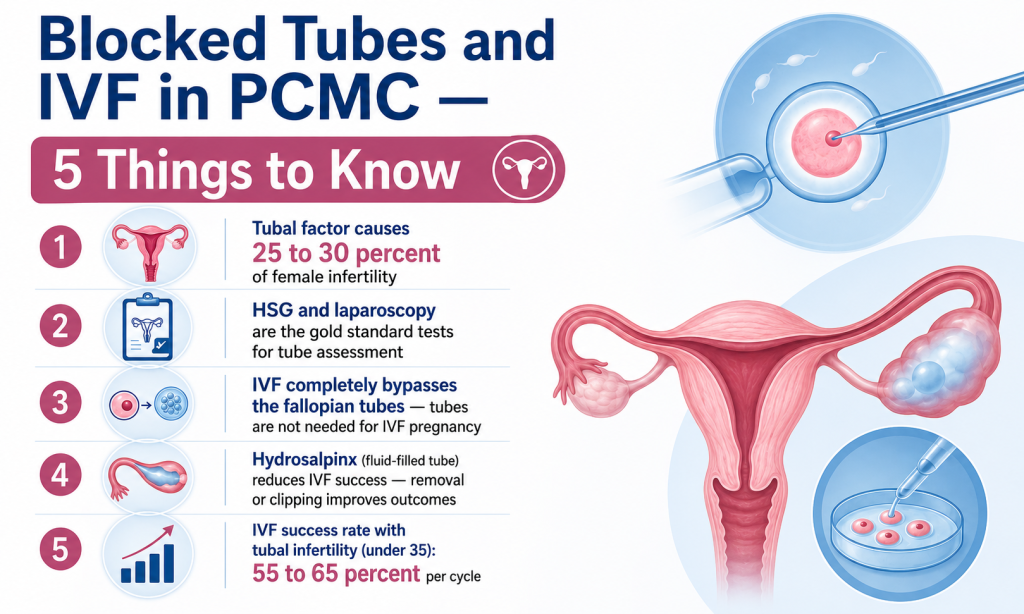
Tubal factor infertility — blocked or damaged fallopian tubes — causes 25 to 30 percent of female infertility cases in India.
IVF completely bypasses the fallopian tubes — fertilisation happens in the laboratory and the embryo is transferred directly into the uterus.
IUI will not work for blocked tubes — IVF is the appropriate treatment.
Hydrosalpinx (fluid-filled blocked tube) reduces IVF success rates and should be surgically treated before IVF.
HSG (hysterosalpingography) is the standard test for diagnosing tubal blockage in PCMC — cost: INR 2,000 to 5,000.
IVF success rate for tubal infertility in PCMC (under 35): 55 to 65 percent per cycle.
What Are Blocked Fallopian Tubes and How Do They Affect Fertility?
Blocked fallopian tubes and IVF in PCMC is a combination that Dr. Shitole’s fertility team manages expertly every month. The fallopian tubes are the anatomical conduits through which an egg travels from the ovary to the uterus and where natural fertilisation occurs. When one or both tubes are blocked or damaged, sperm cannot reach the egg and natural conception becomes impossible.
Tubal factor infertility accounts for approximately 25 to 30 percent of female infertility in India (ICMR 2024). The most common causes are pelvic inflammatory disease (PID) from sexually transmitted infections, previous pelvic surgery, endometriosis, appendicitis with rupture, and hydrosalpinx (fluid accumulation in a damaged tube). IVF is the definitive treatment — it completely removes the fallopian tubes from the equation by creating the embryo in the laboratory and transferring it directly into the uterus.
QUICK FACTS
Tubal Factor Share of Female Infertility: 25 to 30 percent (ICMR 2024)
HSG Test Cost in PCMC: INR 2,000 to 5,000
IVF Success Rate with Tubal Infertility (under 35): 55 to 65 percent
Hydrosalpinx impact on IVF success: Reduces by 30 to 50 percent if untreated
Tubal repair surgery (tuboplasty) success: Low — IVF preferred in most cases
IVF completely bypasses the fallopian tubes: Yes — tubes not needed
PCMC Tubal Infertility Statistics 2025-2026
| Metric | Data Point | Source |
| Tubal factor share of female infertility | 25 to 30 percent | ICMR 2024 |
| Bilateral tubal blockage prevalence in infertile women | 10 to 15 percent | Industry estimate |
| HSG test cost PCMC | INR 2,000 to 5,000 | Industry estimate |
| IVF success rate with tubal infertility (under 35) | 55 to 65 percent per cycle | Industry estimate |
| Hydrosalpinx IVF impact (untreated) | 30 to 50 percent reduction in success | PubMed 2021 |
| Hydrosalpinx treatment improvement | Restores success to standard rates | PubMed 2021 |
| Tuboplasty (tubal repair) pregnancy rate | 15 to 30 percent overall | Industry estimate |
How Are Blocked Fallopian Tubes Diagnosed in PCMC?
HSG — Hysterosalpingography
HSG is the standard first-line test for tubal assessment. A dye is injected through the cervix into the uterus and fallopian tubes under X-ray guidance. If dye flows freely through both tubes and spills into the pelvic cavity, the tubes are open. If dye cannot pass through a tube, blockage is confirmed. HSG cost in PCMC: INR 2,000 to 5,000. It takes 15 to 20 minutes and is done as an outpatient procedure.
Laparoscopy with Chromopertubation
Laparoscopy is the gold standard for tubal assessment — it allows direct visual inspection of the tubes, identification of adhesions and simultaneous treatment if needed. Blue dye is injected through the cervix during laparoscopy — if it flows freely through both tubes, they are open. Laparoscopy also identifies endometriosis, adhesions and other pelvic pathology that HSG cannot show.
Saline Sonography and HyCoSy
HyCoSy (Hystero-Contrast-Sonography) uses ultrasound with a contrast agent to assess tubal patency without X-ray. It’s less widely available than HSG in PCMC but is a radiation-free option. Saline infusion sonography assesses the uterine cavity but not the tubes.
Types of Tubal Blockage and Their Treatment in PCMC
| Type of Blockage | Location | Fertility Impact | Recommended Treatment |
| Proximal tubal blockage | Near the uterus | Moderate — one or both tubes | IVF or selective salpingography |
| Distal tubal blockage | Near the ovary (fimbrial end) | Significant — prevents egg pickup | IVF; hydrosalpinx removal if present |
| Hydrosalpinx | Fluid-filled distal blockage | Severe — toxic to embryo | Salpingectomy or clipping before IVF |
| Complete bilateral blockage | Both tubes fully blocked | Severe — natural conception impossible | IVF — only option |
| Tubal adhesions | External — around the tubes | Moderate — may be surgically divided | Laparoscopic adhesiolysis then natural trial or IVF |
Why Hydrosalpinx Must Be Treated Before IVF in PCMC
Hydrosalpinx — a blocked, fluid-filled fallopian tube — is one of the most important conditions to address before IVF. The fluid in a hydrosalpinx is not neutral. It contains inflammatory cytokines and toxic substances that can leak back into the uterine cavity and damage embryos or impair implantation. Studies consistently show that untreated hydrosalpinx reduces IVF success rates by 30 to 50 percent (PubMed 2021).
The solution is straightforward: salpingectomy (surgical removal of the affected tube) or proximal tubal occlusion (clipping the tube close to the uterus to prevent leakage) before IVF. Removing the tube does not affect IVF success — eggs are retrieved directly from the ovary during IVF, not through the tubes. After treatment of hydrosalpinx, IVF success rates return to the standard range for that patient’s age and diagnosis.
IVF Completely Bypasses Blocked Tubes — How?
This is the key point for women in PCMC with tubal factor infertility: IVF makes the fallopian tubes irrelevant. Here is why:
- In natural conception, the egg is released from the ovary, enters the fallopian tube, is fertilised by sperm in the tube and travels to the uterus as an embryo
- In IVF, the egg is retrieved directly from the ovary via ultrasound-guided aspiration — the fallopian tube is not involved
- The egg is fertilised in the laboratory by the embryologist
- The resulting embryo is placed directly into the uterus via a thin catheter — the fallopian tube is bypassed entirely
This is why IVF achieves the same success rates for women with tubal infertility as for women with other fertility diagnoses — because the tubes are simply not part of the IVF process.
Tubal Infertility and IVF in PCMC — Local Context
Pelvic inflammatory disease — the leading cause of tubal damage — is more prevalent in women with a history of untreated STIs. In PCMC’s younger urban demographic, delayed diagnosis and treatment of chlamydia and gonorrhoea contributes to tubal scarring that only becomes apparent when conception is attempted. Regular STI screening as part of pre-marital health checks is an important preventive step.
Endometriosis-related tubal damage is also commonly seen at Dr. Shitole’s PCMC clinic. Women with Stage 3 or 4 endometriosis often have peritubal adhesions or tubal distortion that — combined with ovarian reserve damage — makes IVF the most efficient path forward without attempting tubal surgery first.
Women from Wakad, Hinjewadi, Nigdi, Bhosari, Chinchwad and Akurdi with known or suspected tubal factor can book a diagnostic workup at Dr. Shitole’s D.Y. Patil Hospital clinic services — HSG, pelvic ultrasound and consultation can often be completed in one visit.
Frequently Asked Questions
Q: Can I get pregnant naturally with one blocked fallopian tube?
Yes. If one tube is open and the ovary on that side functions normally, natural conception is possible. Success rates are lower — approximately half of natural cycles — but pregnancy without IVF is achievable. Your fertility specialist will advise based on which side the open tube is on and which ovary is dominant.
Q: Will IUI work if I have blocked fallopian tubes?
No. IUI places sperm into the uterus, but fertilisation still depends on sperm travelling through an open tube to meet the egg. If both tubes are blocked, IUI is ineffective. If one tube is open, IUI may be attempted but has lower success rates. IVF is the definitive treatment for bilateral tubal blockage.
Q: Is surgery better than IVF for blocked tubes?
For most women, particularly those over 35 or with additional infertility factors, IVF offers higher success rates per treatment than tubal surgery. Tuboplasty (surgical repair) has a 15 to 30 percent overall pregnancy rate and carries a risk of ectopic pregnancy. IVF achieves 55 to 65 percent success per cycle for women under 35. Dr. Shitole will advise based on your age, tube condition and overall fertility picture.
Q: What is the cost of treating tubal infertility with IVF in PCMC?
A complete IVF cycle for tubal infertility in PCMC costs INR 1,30,000 to 2,00,000 including medications. If hydrosalpinx treatment (salpingectomy or tubal clipping) is needed before IVF, add INR 40,000 to 70,000 for the laparoscopic procedure. An itemised estimate is provided at consultation.
Q: Does removing a fallopian tube affect my ovarian reserve?
Salpingectomy (tube removal) can occasionally reduce ovarian blood supply and affect reserve on the operated side. This risk is minimised with careful surgical technique. Dr. Shitole uses meticulous dissection close to the tube and away from the ovarian vessels. Post-operative AMH is checked to confirm reserve status before IVF begins.
Q: How is hydrosalpinx treated before IVF in PCMC?
Hydrosalpinx is treated laparoscopically in one of two ways: salpingectomy (complete removal of the affected tube) or proximal tubal occlusion (clipping the tube close to the uterus to prevent fluid leakage into the uterine cavity). Both approaches restore IVF success rates to expected levels. The choice depends on tube anatomy and patient preference.
Conclusion
Blocked fallopian tubes in PCMC are not the end of your fertility story — they are the beginning of your IVF story. IVF completely bypasses the tubes, achieving pregnancy rates of 55 to 65 percent per cycle for women under 35 regardless of tubal status.
If you’ve been diagnosed with tubal factor infertility, or if your HSG has shown blocked tubes, book a consultation with Dr. Rajendra Shitole at D.Y. Patil Hospital, Pimpri-Chinchwad. He will assess your complete fertility picture and give you a clear, personalised treatment plan.
Visit our website drrajendrashitoleivfdoctor to book your appointment this May.
Blocked tubes are a diagnosis. IVF is the solution. Dr. Shitole’s team is ready to help you get there.

Dr. Rajendra Shitole
Dr. Rajendra Shitole, Best IVF & Fertility Specialist Centre in PCMC . is a highly skilled Gynaecologist, Fertility Consultant, and Laparoscopic & Robotic Surgeon with over 11 years of experience dedicated to women’s health and reproductive care. His mission is to help childless couples fulfill their dream of parenthood through compassionate care and advanced medical expertise.
He has successfully managed numerous complex cases of Infertility, Fibroids, PCOS, Adenomyosis, Endometriosis, and Male Factor Infertility.