KEY TAKEAWAYS
Frozen embryo transfer (FET) in PCMC costs INR 25,000 to 40,000 per cycle — a fraction of the cost of a full fresh IVF cycle.
FET success rates are comparable or superior to fresh transfers in most patient groups — particularly PCOS patients.
No ovarian stimulation injections are needed for a FET cycle — the uterine lining is prepared with oestrogen and progesterone only.
Embryo thaw survival rate with vitrification technology is 90 to 95 percent at established PCMC fertility clinics.
ERA-guided FET — where transfer timing is personalised to the individual’s implantation window — is available at Dr. Shitole’s PCMC clinic.
Embryos can be stored for up to 10 years in India under ICMR 2024 regulations.
What Is a Frozen Embryo Transfer and Why Is It Done in PCMC?
Frozen embryo transfer cost in PCMC 2026 is among the most cost-efficient fertility treatment options available. A frozen embryo transfer (FET) cycle uses embryos that were created during a previous IVF cycle and cryopreserved (frozen) rather than transferred immediately. These embryos are stored in liquid nitrogen until the patient is ready for transfer.
FET is performed instead of a fresh transfer for several reasons: OHSS prevention in PCOS patients (freeze-all strategy), when the uterine lining was not ideal during the stimulation cycle, when PGT-A genetic testing is being done on embryos before transfer, or simply because surplus embryos from a previous fresh cycle are being used. Dr. Rajendra Shitole at D.Y. Patil Hospital, PCMC performs FET cycles using both natural and medicated protocols.
QUICK FACTS
FET Cycle Cost PCMC: INR 25,000 to 40,000
Embryo Thaw Survival Rate: 90 to 95 percent
FET Success Rate (under 35): 45 to 55 percent per transfer
Endometrial Preparation Duration: 14 to 21 days
Transfer Procedure Time: 15 to 20 minutes
Annual Embryo Storage Fee PCMC: INR 10,000 to 20,000
PCMC Frozen Embryo Transfer Statistics 2025-2026
| Metric | Data Point | Source |
| FET cost in PCMC per cycle | INR 25,000 to 40,000 | Industry estimate |
| Embryo thaw survival rate (vitrification) | 90 to 95 percent | Industry estimate |
| FET live birth rate (under 35) | 45 to 55 percent per transfer | ICMR 2024 |
| FET vs fresh transfer success rate | Comparable or slightly better for most patients | PubMed 2022 |
| Annual embryo storage cost PCMC | INR 10,000 to 20,000 | Industry estimate |
| PCOS patients using freeze-all strategy | Majority of PCOS IVF cycles | Industry estimate |
| ERA-guided FET improvement in recurrent failure | Significant improvement in selected cases | PubMed 2022 |
FET Cost Breakdown in PCMC 2026
| Cost Component | Estimated Cost (INR) | Notes |
| FET consultation and baseline scan | 500 to 1,500 | Cycle Day 2 review |
| Oestrogen medication (endometrial prep) | 2,000 to 5,000 | Oral or transdermal oestrogen for 12 to 14 days |
| Endometrial monitoring scans (2 to 3) | 1,000 to 3,000 | Lining thickness and pattern assessment |
| Progesterone support (luteal phase) | 2,000 to 5,000 | Vaginal or IM progesterone from Day 15 |
| Embryo thaw and preparation | 5,000 to 10,000 | Lab fee for warming and quality assessment |
| Embryo transfer procedure | 8,000 to 15,000 | Ultrasound-guided transfer, 15 to 20 minutes |
| Post-transfer luteal support | 2,000 to 4,000 | Progesterone continuation through 12 weeks |
| Beta hCG pregnancy test | 300 to 600 | 14 days post-transfer |
Natural vs Medicated FET Protocol — Which Is Right for You?
| Feature | Natural Cycle FET | Medicated (Artificial) FET |
| Hormones used | None — natural ovulation used | Oestrogen then progesterone |
| Monitoring required | LH surge monitoring | Endometrial scan only |
| Best for | Regular, predictable cycles | Irregular cycles, post-IUI/IVF failure |
| Flexibility | Depends on natural cycle timing | Transfer date can be planned precisely |
| Cost in PCMC | Lower — INR 20,000 to 30,000 | Standard — INR 25,000 to 40,000 |
| Success rate | Comparable | Comparable — slightly more consistent |
The FET Process at Dr. Shitole’s PCMC Clinic — Step by Step
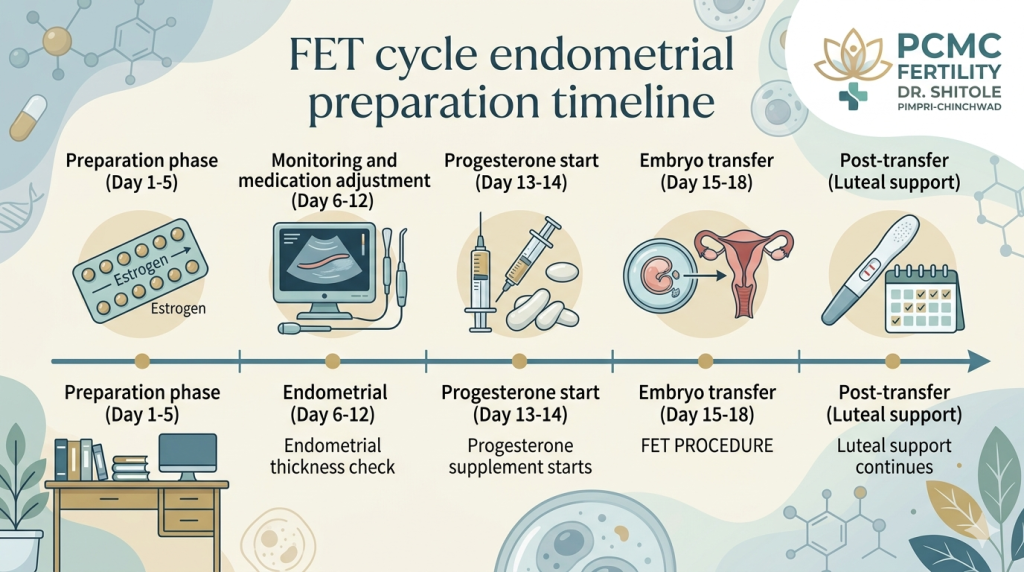
- Consultation (Day 1 to 5 of cycle): Review of frozen embryo status, protocol selection, baseline ultrasound
- Oestrogen start (Day 2 to 3): Oral oestrogen tablets or patches to build the uterine lining
- Monitoring scan (Day 10 to 12): Endometrial thickness measured — target 8 mm or more with trilaminar pattern
- Progesterone start (Day 14 to 16): Vaginal or IM progesterone added once lining is adequate
- Transfer day (Day 19 to 21): Embryo(s) warmed from cryostorage, quality checked under microscope, then transferred via a thin catheter under ultrasound guidance
- Luteal support (post-transfer): Progesterone and oestrogen continued for 12 to 14 days
- Pregnancy test (Day 33 to 35): Beta hCG blood test to confirm pregnancy
Fresh vs Frozen Transfer — Why FET Often Wins in PCMC
Recent research increasingly shows that FET outcomes are comparable to — and in some patient groups better than — fresh embryo transfers (PubMed 2022). The reason: during a stimulation cycle, elevated hormone levels can affect endometrial receptivity. A FET cycle — where the uterus is prepared in a calmer hormonal environment — may offer better implantation conditions.
For PCOS patients, freeze-all and FET is now considered the standard of care at Dr. Shitole’s PCMC clinic. It eliminates OHSS risk completely while delivering success rates of 50 to 65 percent per transfer. For non-PCOS patients, the choice between fresh and frozen transfer is made based on endometrial quality, embryo number and timing considerations.
FET in PCMC — Local Context and Practical Considerations
A FET cycle is significantly simpler than a full IVF cycle. There are no daily injection appointments, no egg retrieval procedure and no anaesthesia. Most monitoring appointments take 20 minutes. This makes FET an ideal option for PCMC couples balancing demanding work schedules in Hinjewadi, Wakad and the IT corridor with fertility treatment.
A couple from Nigdi who had 3 high-quality blastocysts frozen from their first IVF cycle came to Dr. Shitole for their first FET. The entire process — from consultation to transfer — took 21 days and cost INR 32,000 including all medications and scans. Their first thaw resulted in a successful pregnancy. They still have 2 frozen embryos for any future attempts.
Embryo storage note: Frozen embryos at Dr. Shitole’s PCMC clinic are maintained in continuous liquid nitrogen storage with temperature monitoring and backup systems. Annual storage renewal notifications are sent to patients. Under ICMR 2024 regulations, embryos can be stored for up to 10 years.
Frequently Asked Questions
Q: What is the cost of a frozen embryo transfer cycle in PCMC in 2026?
A complete FET cycle in PCMC costs INR 25,000 to 40,000 including endometrial preparation medications, monitoring scans, embryo thaw, transfer procedure and post-transfer support. An itemised quote is provided at your FET consultation with Dr. Shitole.
Q: Is FET success rate the same as fresh IVF?
For most patient groups, FET success rates are comparable to or slightly better than fresh transfer rates (PubMed 2022). FET live birth rate for women under 35 at established PCMC clinics is 45 to 55 percent per transfer. PCOS patients often do better with FET than fresh transfer due to better endometrial conditions.
Q: How many embryos survive the thaw process?
With modern vitrification technology, embryo survival on thawing is 90 to 95 percent at established PCMC fertility clinics. Most vitrified blastocysts survive the thaw with no significant damage. Your embryologist will confirm embryo survival and quality before the transfer.
Q: Can I do an ERA test before my FET in PCMC?
Yes. ERA testing is done in a mock FET cycle — a biopsy of the uterine lining is taken at the exact time transfer would normally occur. The biopsy is analysed and your personalised implantation window is identified. Subsequent FETs are timed to match this window. ERA is recommended for women who have had 2 or more failed embryo transfers with good-quality embryos.
Q: How long do I need to take medications for a FET cycle?
Endometrial preparation with oestrogen starts on Day 2 to 3 of your cycle and continues for 12 to 14 days. Progesterone is added for 5 to 6 days before transfer. Both hormones continue for 12 to 14 weeks if pregnancy is confirmed. Total medication duration for a single FET attempt is approximately 6 weeks.
Q: What happens if my frozen embryo does not survive thawing?
If an embryo does not survive thawing, the transfer is cancelled for that attempt. If you have multiple frozen embryos, the next best-quality embryo will be thawed. Dr. Shitole’s clinic will discuss your embryo inventory with you before each thaw attempt so you understand your options clearly.
Conclusion
Frozen embryo transfer cost in PCMC 2026 — INR 25,000 to 40,000 — makes it the most cost-efficient step in a fertility treatment journey once embryos are already frozen. With 90 to 95 percent thaw survival rates and success rates of 45 to 55 percent per transfer, FET is a reliable, physically gentle and affordable path to pregnancy.
If you have frozen embryos stored at Dr. Shitole’s PCMC clinic or are planning your first FET, book your consultation today to review your embryo status and plan your cycle.

Dr. Rajendra Shitole
Dr. Rajendra Shitole, Best IVF & Fertility Specialist Centre in Kharadi, Pune .He is highly skilled Gynaecologist, Fertility Consultant, and Laparoscopic & Robotic Surgeon with over 11 years of experience dedicated to women’s health and reproductive care. His mission is to help childless couples fulfill their dream of parenthood through compassionate care and advanced medical expertise.
He has successfully managed numerous complex cases of Infertility, Fibroids, PCOS, Adenomyosis, Endometriosis, and Male Factor Infertility.