Table of contents
- What Is the Difference Between ICSI and IVF in PCMC?
- PCMC IVF and ICSI Statistics 2025-2026
- When Is IVF Recommended Over ICSI in PCMC?
- When Is ICSI Recommended in PCMC?
- ICSI vs IVF — Side by Side Comparison
- The ICSI Procedure — What Happens in the Lab?
- A Real-World Example From PCMC
- IVF and ICSI Services in PCMC, Pimpri-Chinchwad
- Frequently Asked Questions
- Conclusion
KEY TAKEAWAYS
ICSI vs IVF treatment PCMC are both in vitro fertilisation methods — the difference is how the sperm and egg are combined.
Intracytoplasmic Sperm Injection involves injecting a single sperm directly into an egg and is recommended for male factor infertility.
ICSI has a higher fertilisation rate (70 to 85 percent) than conventional IVF (60 to 70 percent).
Intracytoplasmic Sperm Injection costs INR 15,000 to 25,000 more than a standard IVF cycle in PCMC.
Couples with unexplained infertility or previous fertilisation failure often benefit from ICSI.
Dr. Shitole’s PCMC clinic recommends ICSI or IVF based on your specific semen analysis and diagnosis.
What Is the Difference Between ICSI and IVF in PCMC?
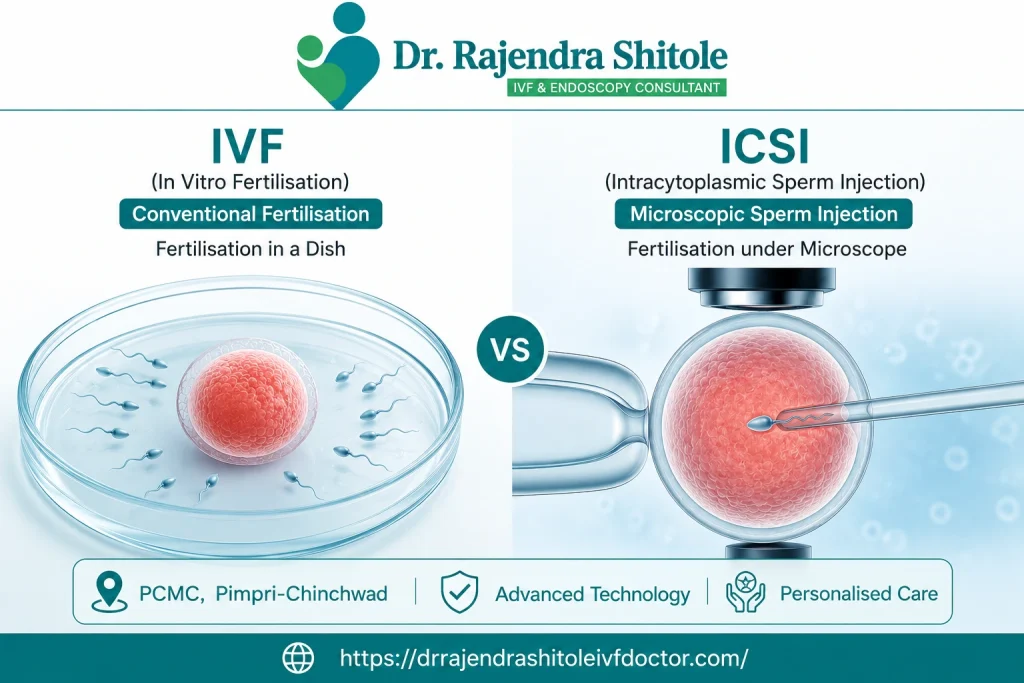
ICSI vs IVF treatment in PCMC is a question Dr. Shitole’s team answers every week at their fertility clinic in Pimpri-Chinchwad. Both are forms of in vitro fertilisation — the embryo is created outside the body in a laboratory. The difference is in how the sperm meets the egg. In conventional IVF, thousands of sperm are placed around an egg in a culture dish and one sperm fertilises naturally. In ICSI, a single selected sperm is injected directly into the egg using a microscopic needle.
ICSI was developed specifically to overcome male factor infertility. It’s now used in over 70 percent of all IVF cycles in India (Industry estimate). This blog, reviewed by Dr. Rajendra Shitole, explains exactly when each treatment is appropriate for couples in PCMC.
QUICK FACTS
IVF Base Cost in PCMC: INR 1,00,000 to 1,40,000
ICSI Add-on Cost: INR 15,000 to 25,000
IVF Fertilisation Rate: 60 to 70 percent of mature eggs
ICSI Fertilisation Rate: 70 to 85 percent of mature eggs
ICSI Usage in India: Over 70 percent of IVF cycles (Industry estimate)
Semen Analysis Cost in PCMC: INR 500 to 1,500
PCMC IVF and ICSI Statistics 2025-2026
| Metric | Data Point | Source |
| ICSI fertilisation success rate | 70 to 85 percent | Industry estimate |
| Conventional IVF fertilisation rate | 60 to 70 percent | Industry estimate |
| Male factor infertility share of cases | 40 to 50 percent | ICMR 2024 |
| ICSI usage in Indian IVF cycles | Over 70 percent | Industry estimate |
| Semen analysis abnormality rate in India | 1 in 3 men tested | ICMR 2024 |
| ICSI add-on cost in PCMC | INR 15,000 to 25,000 | Industry estimate |
| Couples with unexplained infertility benefiting from ICSI | Up to 30 percent | Industry estimate |
When Is IVF Recommended Over ICSI in PCMC?
Standard IVF is appropriate when the male partner has normal sperm parameters — good count, motility and morphology — and the female partner has no history of poor fertilisation. IVF is slightly less invasive to the egg because there is no micromanipulation involved.
Couples with unexplained infertility and normal semen analysis are often started on conventional IVF. If fertilisation rates are unexpectedly low, the embryologist may switch to ICSI in subsequent cycles.
When Is ICSI Recommended in PCMC?
Dr. Shitole recommends ICSI for couples in the following situations:
- Low sperm count (oligozoospermia) — fewer than 15 million sperm per mL
- Poor sperm motility (asthenozoospermia) — less than 40 percent motile
- Abnormal sperm morphology (teratozoospermia) — less than 4 percent normal forms
- Previous IVF cycle with poor or zero fertilisation
- Surgical sperm retrieval (TESA/PESA) — sperm obtained directly from testis or epididymis
- Frozen sperm being used — ICSI improves fertilisation when sperm quality is reduced by freezing
- Unexplained infertility with previous failed treatments
ICSI vs IVF — Side by Side Comparison
| Feature | Conventional IVF | ICSI |
| Fertilisation method | Sperm placed near egg | Single sperm injected into egg |
| Best suited for | Normal semen parameters | Male factor infertility |
| Fertilisation rate | 60 to 70 percent | 70 to 85 percent |
| Additional cost in PCMC | Base cycle fee only | INR 15,000 to 25,000 extra |
| Embryo quality | Comparable | Comparable |
| Success rate | Similar overall | Similar overall |
| Egg manipulation | Minimal | Micromanipulation required |
The ICSI Procedure — What Happens in the Lab?
The ICSI process begins after egg retrieval from the female partner. An embryologist selects the best-quality sperm from the semen sample under high magnification. A glass micropipette holds the egg steady while an injection needle introduces a single sperm through the outer shell (zona pellucida) directly into the cytoplasm.
The next day, the embryologist checks for fertilisation. Successfully fertilised eggs continue to the blastocyst stage (Day 5) for transfer or freezing. The entire process takes place in Dr. Shitole’s state-of-the-art embryology laboratory at his PCMC clinic.
A Real-World Example From PCMC
A couple from Bhosari, PCMC — the husband worked at a manufacturing unit near Chinchwad — consulted Dr. Shitole after 18 months of unsuccessful attempts. Semen analysis revealed a count of 8 million per mL with 28 percent motility. Standard IVF was unlikely to result in adequate fertilisation. Dr. Shitole recommended ICSI. In one cycle, 9 eggs were retrieved, 7 were fertilised via ICSI and 2 high-quality blastocysts were transferred. The couple achieved a singleton pregnancy on the first attempt.
IVF and ICSI Services in PCMC, Pimpri-Chinchwad
Both IVF and ICSI are available at Dr. Shitole’s fertility centre at D.Y. Patil Hospital, Pimpri-Chinchwad. Couples from Wakad, Hinjewadi, Nigdi, Akurdi, Chinchwad, Bhosari, Moshi and Talegaon Dabhade regularly access fertility treatment here. The clinic’s in-house embryology laboratory maintains strict quality controls with dedicated senior embryologists on every cycle.
Dr. Shitole’s team will determine whether IVF or ICSI is right for you based on your full diagnostic workup — semen analysis, ovarian reserve tests and medical history. No blanket protocol is applied.
Frequently Asked Questions
Q: Is ICSI better than IVF in PCMC?
ICSI is not universally ‘better’ — it is better for specific situations, particularly male factor infertility. For couples with normal semen parameters, conventional IVF may be equally effective and slightly less expensive. Your fertility specialist will advise based on your semen analysis results.
Q: Does ICSI improve pregnancy success rate?
ICSI improves fertilisation rates compared to conventional IVF when sperm parameters are abnormal. The overall live birth rate per cycle is similar between IVF and ICSI when comparing matched patient populations. The key benefit is ensuring fertilisation happens when sperm quality is poor.
Q: What is the cost of ICSI in PCMC in 2026?
ICSI in PCMC costs INR 15,000 to 25,000 as an add-on to the base IVF cycle fee of INR 1,00,000 to 1,40,000. Total ICSI cycle cost including medications is approximately INR 1,50,000 to 2,20,000. An itemised quote is provided at Dr. Shitole’s first consultation.
Q: Is ICSI painful for the woman?
The female experience of ICSI is identical to standard IVF. The only difference is in the embryology laboratory. Egg retrieval is done under sedation and takes 15 to 30 minutes. The ICSI microinjection happens after retrieval and the woman is not involved in that step.
Q: Can ICSI help if my husband has zero sperm count?
In cases of azoospermia (zero sperm in ejaculate), sperm can be surgically retrieved from the testis via TESA or micro-TESE and used directly for ICSI. This is available at Dr. Shitole’s PCMC clinic. Success depends on whether viable sperm are found in testicular tissue.
Q: How do I know if I need ICSI or IVF?
A semen analysis is the primary deciding factor. Normal parameters point toward conventional IVF; abnormal parameters indicate ICSI. Your doctor will also consider your partner’s history, previous cycle outcomes and any known uterine or ovarian factors.
Conclusion
ICSI vs IVF treatment in PCMC is not a competition — it’s a clinical decision based on your specific diagnosis. For couples with male factor infertility, previous failed fertilisation or surgical sperm retrieval, ICSI offers a significantly better fertilisation rate. For couples with normal semen analysis, conventional IVF is a well-established option.
Dr. Rajendra Shitole at his PCMC fertility clinic guides every couple through this decision with transparent pricing, thorough diagnostics and a personalised treatment plan.
Book your consultation today drrajendrashitoleivfdoctor

Dr. Rajendra Shitole
Dr. Rajendra Shitole, Best IVF & Fertility Specialist Centre in Kharadi, Pune .He is highly skilled Gynaecologist, Fertility Consultant, and Laparoscopic & Robotic Surgeon with over 11 years of experience dedicated to women’s health and reproductive care. His mission is to help childless couples fulfill their dream of parenthood through compassionate care and advanced medical expertise.
He has successfully managed numerous complex cases of Infertility, Fibroids, PCOS, Adenomyosis, Endometriosis, and Male Factor Infertility.