KEY TAKEAWAYS FOR FERTILITY PRESERVATION
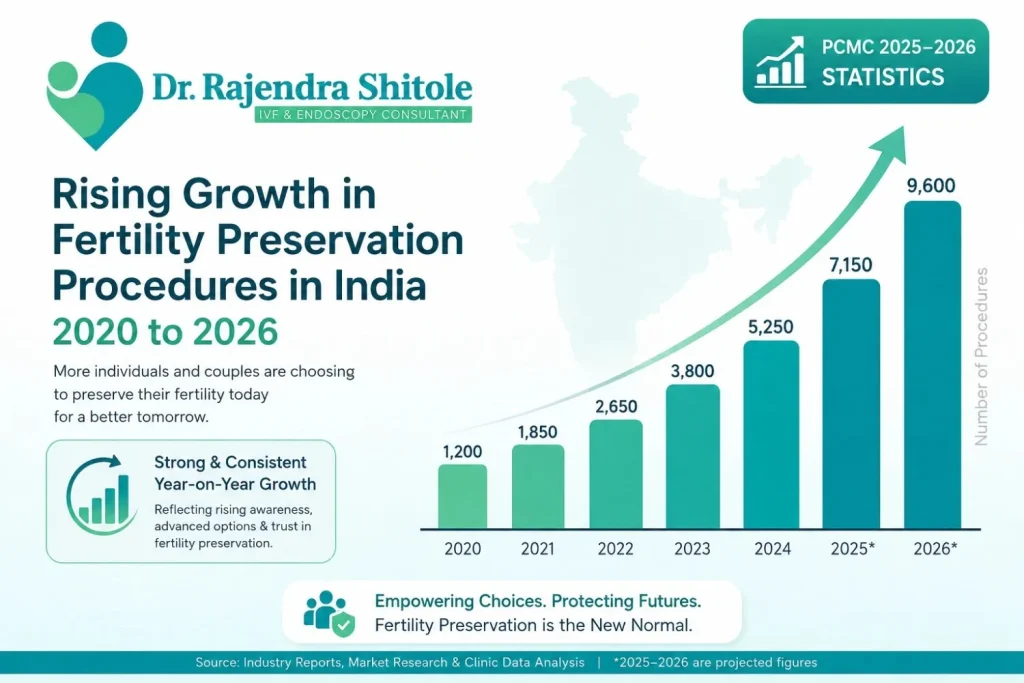
- Fertility preservation in PCMC is growing at approximately 25 percent per year, driven by professional and medical demand.
- Social egg freezing — for career or personal reasons — now accounts for over 40 percent of preservation cycles at established clinics.
- The optimal window for egg freezing is 28 to 33 years — when egg quality and quantity are both high.
- ICMR 2024 guidelines permit egg storage for up to 10 years in India.
- Medical egg freezing before cancer treatment or major surgery is available on priority scheduling at Dr. Shitole’s PCMC clinic.
- Women’s Health Month in March is a reminder to prioritise your reproductive health — starting with an AMH test.
The Fertility Preservation Trend in PCMC — What’s Driving It?
Fertility preservation in PCMC 2026 is no longer a niche choice. It’s a mainstream conversation among professional women in Pimpri-Chinchwad. Dr. Rajendra Shitole’s clinic at D.Y. Patil Hospital has seen a consistent year-on-year rise in egg freezing consultations — with most enquiries coming from women aged 28 to 36 working in IT, banking, healthcare and education sectors across PCMC.
This Women’s Health Month, Dr. Shitole explores the real reasons behind this trend — and why PCMC women are making proactive fertility decisions earlier than any previous generation. This content is reviewed and endorsed by Dr. Shitole based on his clinical experience and ICMR 2024 guidelines.
QUICK FACTS
- Annual growth in fertility preservation in India: Approx. 25 percent (Industry estimate)
- Social vs medical egg freezing ratio at PCMC clinics: Approx. 40:60 (Industry estimate)
- Optimal age for egg freezing: 28 to 33 years (ICMR 2024)
- Maximum legal storage in India: 10 years (ICMR 2024)
- Egg vitrification survival rate on thaw: 80 to 90 percent (Industry estimate)
- AMH test cost in PCMC: INR 800 to 1,500
PCMC Fertility Preservation Statistics 2025-2026
| Metric | Data Point | Source |
| Annual growth in egg freezing in India | Approx. 25 percent per year | Industry estimate |
| Social egg freezing share of procedures | Over 40 percent | Industry estimate |
| Optimal age for egg freezing | 28 to 33 years | ICMR 2024 |
| Egg vitrification survival rate on thaw | 80 to 90 percent | Industry estimate |
| IVF live birth rate with frozen eggs (under 35) | 45 to 55 percent per transfer | Industry estimate |
| Maximum egg storage period in India | 10 years | ICMR 2024 |
| Women with endometriosis at risk of early reserve decline | 1 in 10 women | Industry estimate |
| Fertility check-up awareness among Indian women 25 to 35 | Rising sharply post-2022 | Industry estimate |
Reason 1 — Career and Professional Goals in PCMC
Pimpri-Chinchwad’s IT corridor — stretching from Hinjewadi through Wakad to Baner — employs tens of thousands of women in demanding roles. Many are in their prime career-building years between 28 and 35. Family planning is a real consideration, but one they want to time on their own terms.
Egg freezing gives these women a biological safety net. It doesn’t guarantee a baby — but it preserves options. A woman who freezes 14 mature eggs at 31 has a significantly better chance of using those eggs successfully at 38 than if she had waited and tried to retrieve at 38 directly.
Reason 2 — Pre-Marriage Fertility Planning
Many unmarried women in PCMC in their late 20s and early 30s are proactively freezing eggs before marriage. The Indian wedding season — running from November to February — brings a wave of consultations at Dr. Shitole’s clinic from women in the engagement stage who want to understand their fertility before committing to a family timeline.
This is not pessimism about marriage — it’s reproductive intelligence. Knowing your AMH and antral follicle count before your wedding gives you and your partner realistic information to plan with.
Reason 3 — Medical Indications in PCMC Women
Several medical conditions accelerate egg reserve decline and make early fertility preservation clinically advisable:
| Medical Condition | Fertility Risk | Why Preserve Now |
| Endometriosis | Ovarian reserve damage from cysts or surgery | Preserve before repeat surgery |
| PCOS | Not reserve-reducing, but long-term risk of early menopause | Preserve as insurance |
| Premature Ovarian Insufficiency (POI) family history | Early menopause risk | Preserve urgently at diagnosis |
| Cancer diagnosis | Chemotherapy/radiation destroys eggs | Urgent preservation before treatment |
| Autoimmune conditions (lupus, rheumatoid arthritis) | Some treatments harm ovaries | Preserve before immunosuppressives |
| Single uterine ovary or previous ovarian surgery | Reduced reserve post-surgery | Preserve remaining eggs |
Reason 4 — Rising Awareness and Social Acceptance in PCMC
Five years ago, egg freezing in PCMC was whispered about. Today, it’s openly discussed among friends, colleagues and family groups in Chinchwad, Wakad and Hinjewadi. Social media, workplace wellness programmes and celebrity conversations have normalised fertility preservation as a health choice, not a medical emergency.
Dr. Shitole’s clinic runs free fertility awareness webinars for corporate employees in the PCMC industrial and IT belt. These sessions have contributed significantly to earlier consultations and better-informed decisions among PCMC women.
What Does Fertility Preservation Involve? Process Overview
| Stage | Timeline | What Happens |
| Consultation and tests | Day 1 to 5 of cycle | AMH, AFC scan, hormone panel, treatment plan |
| Ovarian stimulation | Days 2 to 14 | Daily injection protocol, monitoring scans |
| Trigger injection | Day 12 to 14 | Final egg maturation trigger |
| Egg retrieval (OPU) | Day 14 to 15 | Under sedation, 15 to 30 minutes |
| Vitrification | Same day as retrieval | Flash-freeze using liquid nitrogen |
| Storage | Ongoing | Stored at -196 degrees Celsius, up to 10 years |
Fertility Preservation in PCMC — Women-Specific Lifestyle Context
For women in PCMC, hormonal context matters. Menstrual irregularity is common among women in high-stress corporate roles. PCOS affects an estimated 1 in 5 women in India (Industry estimate). Both conditions can create a false sense of fertility security — irregular periods do not mean poor fertility, but they do need monitoring.
Diet and physical activity specific to PCMC women: the long working hours and readily available processed food in IT canteens and food delivery apps have contributed to rising rates of insulin resistance in PCMC women aged 25 to 35. Insulin resistance worsens hormonal imbalances that affect both natural fertility and IVF response. Addressing diet before egg freezing improves stimulation outcomes.
This Women’s Health Month, Dr. Shitole’s PCMC clinic is offering a discounted fertility check package — AMH test, AFC ultrasound and 30-minute consultation — for women aged 25 to 38. Visit rajendra shitole clinic to book appointment
FAQ
Q: Is fertility preservation in PCMC worth the cost?
For women aged 28 to 35 with a reasonable egg reserve, fertility preservation is a meaningful investment in reproductive options. At a total first-year cost of INR 1,05,000 to 1,65,000, it preserves eggs at their current quality for future use. Whether it’s ‘worth it’ depends on your personal timeline and AMH level — Dr. Shitole will advise based on your specific results.
Q: How do I know if I need to freeze my eggs now?
An AMH blood test and antral follicle count (AFC) ultrasound give you a picture of your current egg reserve. If your AMH is declining or below average for your age, earlier preservation makes more sense. If your reserve is healthy, you have more time. Either way, the information is valuable. The test takes one morning at Dr. Shitole’s PCMC clinic.
Q: Can I freeze embryos instead of eggs in PCMC?
Yes. Embryo freezing (fertilising eggs with your partner’s sperm before freezing) offers slightly higher thaw survival rates than egg freezing. It requires a partner’s sperm at the time of retrieval. Single women or those without a partner freeze eggs only. Both options are available at Dr. Shitole’s PCMC fertility clinic.
Q: Does PCOS affect egg freezing success in PCMC?
Women with PCOS typically retrieve more eggs per cycle due to a higher antral follicle count. However, stimulation must be carefully managed to avoid OHSS. Dr. Shitole uses modified low-dose protocols and GnRH agonist triggers for PCOS patients to minimise risk while maximising egg yield.
Q: Is egg freezing covered by insurance in India?
Medical egg freezing before cancer treatment is sometimes covered by insurance — check your policy carefully. Social egg freezing is not covered by most standard Indian health plans. Some corporate group plans in the PCMC IT sector are beginning to offer fertility benefits. Dr. Shitole’s team can provide documentation for any reimbursement claims.
Q: Can I still get pregnant naturally after freezing my eggs?
Yes. Egg freezing removes only the eggs that would naturally die off that cycle — it does not reduce your remaining ovarian reserve or affect natural ovulation. Many women who freeze eggs go on to conceive naturally before they ever need to use their frozen eggs.
Conclusion
Fertility preservation in PCMC 2026 is driven by informed, forward-thinking women who understand their biology and want choices. Whether the reason is career, relationships, medical conditions or simply wanting more time, egg and embryo freezing at Dr. Shitole’s Pimpri-Chinchwad clinic offers a reliable, scientifically validated option.
This Women’s Health Month, take the first step — an AMH test and a 30-minute consultation. It costs very little and gives you information that could shape important decisions.
Book your fertility preservation consultation today drrajendrashitoleivfdoctor
Your fertility health is worth prioritising. Dr. Shitole and his team of 17+ specialists at D.Y. Patil Hospital, PCMC are ready to help you understand your options — with warmth, accuracy and respect.

Dr. Rajendra Shitole
Dr. Rajendra Shitole, Best IVF & Fertility Specialist Centre in Kharadi, Pune .He is highly skilled Gynaecologist, Fertility Consultant, and Laparoscopic & Robotic Surgeon with over 11 years of experience dedicated to women’s health and reproductive care. His mission is to help childless couples fulfill their dream of parenthood through compassionate care and advanced medical expertise.
He has successfully managed numerous complex cases of Infertility, Fibroids, PCOS, Adenomyosis, Endometriosis, and Male Factor Infertility.