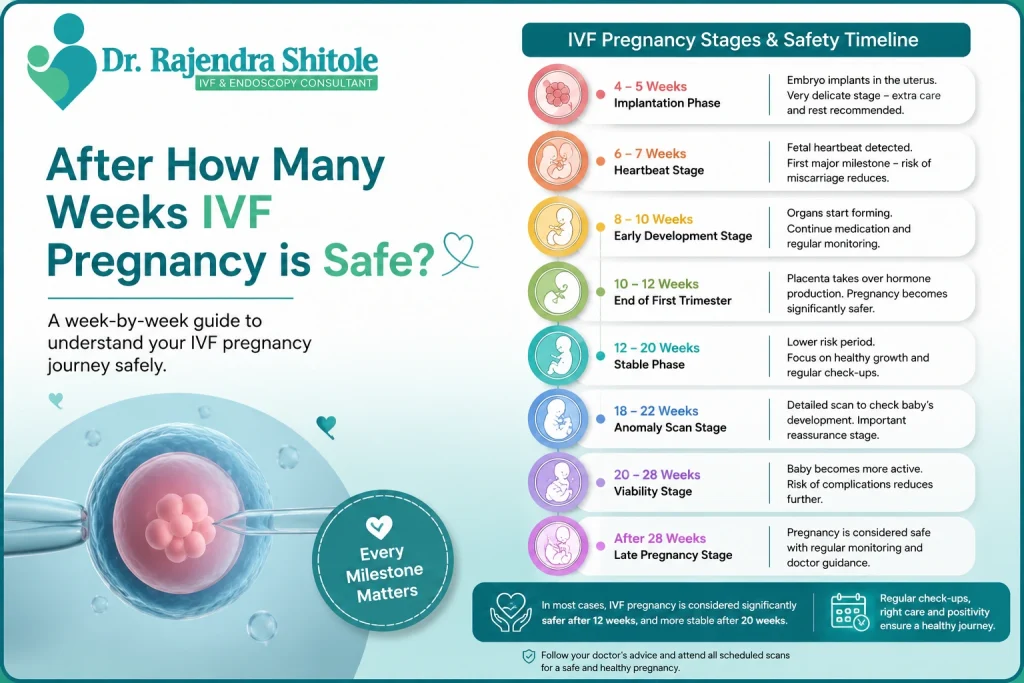
IVF pregnancy is often emotionally intense for couples who have already been through fertility challenges. After the embryo transfer and a positive test, one of the most common and anxious questions patients ask is: After how many weeks IVF pregnancy is safe? The truth is given by Dr. Rajendra Shitole to her patients , IVF pregnancy follows the same biological journey as natural pregnancy, but it is usually monitored more closely in the early weeks. However, there are certain milestones where doctors consider the pregnancy more stable and “safer.”
Let’s understand this in a simple, real, and medically accurate way.
Understanding IVF Pregnancy vs Natural Pregnancy
Before we talk about safety weeks, it is important to understand one key point:
👉 IVF pregnancy is biologically the same as natural pregnancy.
The only difference is how fertilization happens:
- Natural pregnancy: fertilization happens inside the fallopian tube
- IVF pregnancy: fertilization happens in the lab and embryo is transferred into the uterus
Once implantation is successful, the pregnancy follows the same developmental stages.
However, IVF pregnancies are monitored more closely because:
- History of infertility may exist
- Hormonal support is externally provided
- Early pregnancy is more emotionally sensitive for couples
So when we ask after how many weeks IVF pregnancy is safe, we are really asking:
👉 “When does miscarriage risk reduce and pregnancy become stable?”
IVF Pregnancy Week-by-Week Guide (Detailed Medical Explanation)
Understanding IVF pregnancy in stages helps reduce anxiety and gives clarity about what is happening inside the body. Below is a detailed breakdown of each important phase.
4 to 5 Weeks: Implantation and Very Early Pregnancy Stage
This is the earliest confirmed stage of pregnancy after IVF transfer.
At this point:
- The embryo has successfully implanted into the uterine lining
- The placenta has not fully formed yet
- The body starts producing hCG hormone
- Pregnancy test becomes positive
What is happening inside the body:
The fertilized embryo is still very small, but it begins attaching deeply to the uterine wall. This attachment process is delicate because the embryo is still “settling” into the uterus.
Symptoms you may notice:
- Mild lower abdominal cramps (similar to period pain)
- Breast tenderness
- Fatigue and sleepiness
- Light bloating
Medical importance:
- This is the highest-risk stage of IVF pregnancy
- Even small hormonal changes can affect implantation stability
- Doctors focus mainly on supporting hormones (progesterone, estrogen)
👉 At this stage, pregnancy is confirmed, but not stable.
6 to 7 Weeks: Heartbeat Confirmation Stage
This is one of the most emotional milestones for IVF couples.
At this stage:
- Gestational sac is clearly visible
- Yolk sac supports early development
- Fetal heartbeat can usually be detected via ultrasound
What doctors check:
- Presence of heartbeat
- Proper implantation inside uterus
- Growth consistency
Why this stage is important:
Once the heartbeat is seen:
- Miscarriage risk reduces significantly
- Pregnancy is considered viable
- Emotional reassurance increases for the couple
What you may feel:
- Morning sickness may start
- Food aversions
- Fatigue increases
👉 This is still early pregnancy, but it is a strong positive milestone.
8 to 10 Weeks: Embryo Growth and Organ Formation Stage
This is a very active developmental phase.
Inside the womb:
- Embryo rapidly grows into a fetus
- Major organs start forming (brain, heart, liver)
- Placenta begins functioning more actively
- Amniotic sac expands
Symptoms during this stage:
- Nausea and vomiting (morning sickness peak)
- Extreme fatigue
- Mood swings due to hormones
- Increased sensitivity to smell and taste
Medical care:
- Hormonal support continues (especially progesterone)
- Follow-up scans may be done if needed
- Doctors ensure steady growth pattern
👉 Although progress is strong, this stage is still considered clinically sensitive.
10 to 12 Weeks: First Trimester Completion (Critical Turning Point)
This is one of the most important milestones in IVF pregnancy safety.
At this stage:
- Embryo officially becomes a fetus
- Major organs are formed
- Placenta takes over hormone production
- Umbilical cord fully supports nourishment
Why 12 weeks is important:
- Miscarriage risk drops significantly after this stage
- Hormonal dependence reduces
- Pregnancy becomes biologically more stable
Emotional impact:
Most IVF couples feel a sense of relief here because:
- First trimester is successfully completed
- Early uncertainty reduces
👉 Clinically, this is the stage where doctors say:
pregnancy is significantly safer after 12 weeks
12 to 20 Weeks: Stable Second Trimester Phase
This phase is often called the “comfortable phase” of pregnancy.
At this stage:
- Energy levels improve
- Morning sickness usually reduces
- Appetite returns
- Baby grows steadily
What is happening inside:
- Baby’s bones start strengthening
- Facial features become more defined
- Movements may begin (not always felt yet)
- Placenta is fully functional
Medical monitoring:
- Routine antenatal checkups
- Growth tracking scans if needed
- Blood tests for maternal health
👉 This is considered a low-risk and stable phase compared to early pregnancy.
This is one of the most important diagnostic stages in pregnancy.
18 to 22 Weeks: Anatomy Scan and Structural Development Stage
A detailed anomaly scan checks:
- Brain development
- Heart structure
- Spine and limbs
- Kidney and internal organs
- Placenta position
- Amniotic fluid levels
Why this scan is crucial:
It confirms:
- Baby is developing structurally normal
- No major congenital anomalies
- Growth is appropriate for gestational age
Emotional significance:
For many couples, this scan provides:
👉 strong reassurance that pregnancy is progressing normally
20 to 28 Weeks: Viability and Strong Growth Phase
This stage marks a major medical milestone.
At this stage:
- Baby reaches viability outside the womb with medical support
- Lungs start developing rapidly
- Fat deposition begins
- Strong movement may be felt by the mother
What doctors monitor:
- Fetal growth rate
- Blood flow through placenta (Doppler studies)
- Maternal blood pressure
- Sugar levels (gestational diabetes screening)
Why this stage is important:
Even if premature birth occurs:
👉 Baby has a high survival chance with NICU care
This makes pregnancy significantly more stable.
After 28 Weeks: Late Pregnancy Stability Phase
This is the final stretch of pregnancy.
At this stage:
- Baby gains rapid weight
- Lungs mature further
- Brain development continues
- Position of baby (head down or breech) is checked
Medical focus:
- Regular growth scans
- Blood pressure monitoring
- Fetal movement tracking
- Delivery planning
Risk level:
- Major pregnancy risks reduce significantly
- Focus shifts to safe delivery
👉 This is considered a highly stable phase of pregnancy
Top 10 Reasons Why IVF Pregnancy Needs Extra Care in Early Weeks
IVF pregnancy is a beautiful but medically sensitive journey, especially during the early weeks (4 to 12 weeks). While the pregnancy is biologically similar to natural conception after implantation, it requires extra care, monitoring, and medical support in the beginning phase.
Below are the top 10 medically important reasons why IVF pregnancy needs extra care in early weeks, explained in a simple and patient-friendly way.
1. Implantation is Still Stabilizing
In the early weeks after embryo transfer, the embryo is still firmly attaching and settling into the uterine lining.
Explanation:
- The embryo is very small and developing rapidly
- Attachment to uterus is still strengthening
- Even minor hormonal or physical changes can affect stability
👉 This is why doctors closely monitor early implantation to ensure pregnancy continues safely.
2. Hormonal Support is Completely Medication-Dependent
Unlike natural pregnancy, IVF pregnancy often depends on external hormones in early weeks.
Explanation:
- Progesterone and estrogen are given as support
- Body has not yet fully taken over hormone production
- Missing or irregular medication can impact pregnancy stability
👉 Strict medication adherence is extremely important in IVF pregnancy.
3. Placenta is Not Fully Developed Yet
Until around 10–12 weeks, the placenta is still forming.
Explanation:
- Placenta has not taken full control of pregnancy support
- Nutrients and hormones are partially dependent on medication
- Transition phase is biologically sensitive
👉 Extra care ensures smooth placenta development and proper pregnancy progression.
4. Naturally Higher Early Pregnancy Risk
All pregnancies carry risk in early weeks, but IVF pregnancies are closely monitored due to prior infertility history.
Explanation:
- Most miscarriages occur in the first trimester
- Embryo development is still in early stages
- Stability is not fully established
👉 Careful monitoring helps reduce risk during this critical phase.
5. Underlying Infertility Conditions May Exist
IVF is usually recommended due to fertility challenges such as:
- PCOS
- Endometriosis
- Male factor infertility
- Low ovarian reserve
- Hormonal imbalance
Explanation:
These conditions may still influence early pregnancy health.
👉 Extra care ensures these factors are managed properly during pregnancy.
6. Emotional Stress and Anxiety is Higher
IVF pregnancy is emotionally intense for most couples.
Explanation:
- Long wait before conception
- Fear of miscarriage after positive test
- Overthinking every symptom
- Stress between scan intervals
👉 Emotional stress can indirectly affect physical well-being, so reassurance is important.
7. Symptoms Can Be Misleading or Overinterpreted
Early IVF pregnancy symptoms are often confusing.
Explanation:
Common symptoms include:
- Cramping
- Bloating
- Fatigue
- Nausea
- Breast tenderness
These are normal but often misinterpreted as danger signs.
👉 Extra care helps patients understand normal vs concerning symptoms correctly.
8. Frequent Monitoring is Required for Safety
IVF pregnancies involve scheduled early scans:
- 4–5 weeks: implantation confirmation
- 6–7 weeks: heartbeat detection
- 8–10 weeks: growth check
- 12 weeks: first trimester screening
Explanation:
Regular monitoring ensures:
- Proper fetal development
- Healthy heartbeat progression
- No early complications
👉 This structured follow-up is essential for IVF safety.
9. Pregnancy Depends on Precise Timing and Support
IVF pregnancy is highly time-sensitive in early weeks.
Explanation:
- Hormonal levels must be balanced correctly
- Medication timing is very important
- Even small delays can affect stability
👉 Precision in treatment is key to successful early pregnancy development.
10. Transition Phase Between Embryo and Fetus
Around 8 to 12 weeks, the embryo develops into a fetus.
Explanation:
- Major organs start forming
- Placenta becomes more functional
- Body systems begin developing rapidly
👉 This transition phase is delicate, requiring careful observation until stability is achieved.
Expert Medical Insight
Dr. Rajendra Shitole
Dr. Rajendra Shitole, a fertility specialist based in Pune, highlights that early IVF pregnancy requires structured care and consistent monitoring.
According to his clinical experience:
- First 12 weeks are the most sensitive phase
- Regular scans improve safety and reassurance
- Hormonal support must be strictly followed
- Emotional counselling is equally important as medical treatment
His approach at his fertility practice focuses on personalized IVF care, ensuring both physical and emotional stability during early pregnancy.
Book Your Free Appointment For Best Consultation

Dr. Rajendra Shitole
Dr. Rajendra Shitole, Best IVF & Fertility Specialist Centre in Kharadi, Pune .He is highly skilled Gynaecologist, Fertility Consultant, and Laparoscopic & Robotic Surgeon with over 11 years of experience dedicated to women’s health and reproductive care. His mission is to help childless couples fulfill their dream of parenthood through compassionate care and advanced medical expertise.
He has successfully managed numerous complex cases of Infertility, Fibroids, PCOS, Adenomyosis, Endometriosis, and Male Factor Infertility.