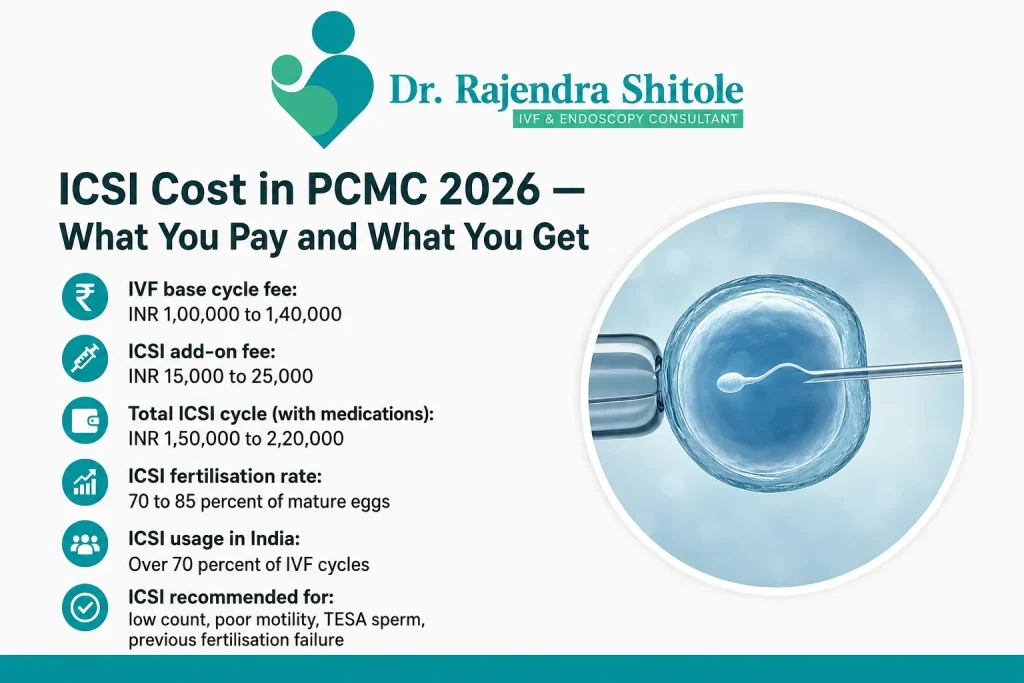
Key Takeways ICSI treatment cost PCMC 2026
- ICSI in PCMC costs INR 15,000 to 25,000 as an add-on to the IVF base cycle fee of INR 1,00,000 to 1,40,000.
- Total ICSI cycle cost in PCMC including all medications is approximately INR 1,50,000 to 2,20,000.
- ICSI achieves a fertilisation rate of 70 to 85 percent of mature eggs — higher than conventional IVF for male factor cases.
- Over 70 percent of all IVF cycles in India now use ICSI as the fertilisation method (Industry estimate).
- ICSI is the standard recommendation at Dr. Shitole’s PCMC clinic when sperm parameters are abnormal or when TESA sperm is used.
- The ICSI procedure is performed entirely in the embryology lab — the female patient’s experience is identical to standard IVF.
What Is ICSI and Why Is It So Widely Used in PCMC?
ICSI treatment cost in PCMC 2026 is a top query among couples where male factor infertility has been identified. Intracytoplasmic Sperm Injection (ICSI) is a specialised IVF technique where a single sperm is selected and injected directly into each mature egg using a micromanipulation system. Unlike conventional IVF — where sperm are placed near the egg and fertilisation is left to occur naturally — ICSI guarantees sperm entry into the egg regardless of sperm count or motility.
Dr. Rajendra Shitole at D.Y. Patil Hospital, PCMC recommends ICSI for all couples with male factor infertility, previous IVF fertilisation failure, surgically retrieved sperm (TESA/PESA) or frozen sperm. It is the most commonly used fertilisation method at his clinic — and in India broadly, where over 70 percent of IVF cycles now use ICSI (Industry estimate). This guide breaks down the full cost, what the procedure involves and what success rates to expect.
QUICK FACTS of ICSI treatment cost PCMC 2026
- ICSI Add-on Cost PCMC: INR 15,000 to 25,000
- Total ICSI Cycle Cost (all inclusive): INR 1,50,000 to 2,20,000
- ICSI Fertilisation Rate: 70 to 85 percent of mature eggs
- Conventional IVF Fertilisation Rate: 60 to 70 percent
ICSI Usage in India: Over 70 percent of IVF cycles
- Sperm Needed for ICSI: As few as 1 viable sperm per egg
PCMC ICSI Treatment Statistics 2025-2026
| Metric | Data Point | Source |
| ICSI add-on cost PCMC | INR 15,000 to 25,000 | Industry estimate |
| Total ICSI cycle cost (with medications) | INR 1,50,000 to 2,20,000 | Industry estimate |
| ICSI fertilisation rate | 70 to 85 percent | Industry estimate |
| Conventional IVF fertilisation rate | 60 to 70 percent | Industry estimate |
| ICSI usage in Indian IVF cycles | Over 70 percent | Industry estimate |
| Male factor contribution to infertility | 40 to 50 percent | ICMR 2024 |
| ICSI success rate per cycle (under 35) | 55 to 65 percent live birth | Industry estimate |
ICSI Cost Breakdown in PCMC 2026 — Every Line Item
| Cost Component | Estimated Cost (INR) | Notes |
| Initial fertility consultation | 500 to 2,000 | Review semen analysis, diagnosis, protocol plan |
| Pre-cycle blood tests and scans | 3,000 to 8,000 | AMH, hormones, semen analysis, pelvic scan |
| Ovarian stimulation medications | 30,000 to 60,000 | Gonadotropin injections for 10 to 14 days |
| Monitoring ultrasounds (4 to 6) | 2,000 to 6,000 | Follicle tracking every 2 to 3 days |
| Anaesthesia for egg retrieval | 4,000 to 8,000 | IV sedation for OPU procedure |
| Egg retrieval procedure (OPU) | 30,000 to 50,000 | Ultrasound-guided follicle aspiration |
| ICSI fertilisation lab fee | 15,000 to 25,000 | Microinjection, embryo culture to blastocyst |
| Embryo transfer procedure | 8,000 to 15,000 | Ultrasound-guided fresh or frozen transfer |
| Post-transfer luteal support | 3,000 to 6,000 | Progesterone and oestrogen |
| Pregnancy test (Beta hCG) | 300 to 600 | 14 days post-transfer |
When Is ICSI Recommended Over Conventional IVF in PCMC?
| Clinical Situation | IVF Appropriate? | ICSI Recommended? | Reason |
| Normal semen parameters | Yes | Optional | Fertilisation likely to occur naturally |
| Low sperm count (below 15M/mL) | Marginal | Yes | Too few sperm for natural fertilisation in dish |
| Poor sperm motility (below 40%) | Marginal | Yes | Motility needed for natural IVF fertilisation |
| Poor morphology (below 4% normal) | Marginal | Yes | Abnormal morphology reduces natural fertilisation |
| TESA or PESA sperm | No | Yes | Retrieved sperm require direct injection |
| Frozen sperm (reduced viability) | Marginal | Yes | Freezing reduces motility — ICSI more reliable |
| Previous IVF fertilisation failure | No | Yes | Corrects unidentified fertilisation barrier |
| Unexplained infertility (selected cases) | Yes | Optional | May improve fertilisation in selected cases |
The ICSI Procedure — What Happens in the Lab at Dr. Shitole’s PCMC Clinic?
On the morning of egg retrieval, the male partner provides a semen sample. The embryology team prepares the sample — washing, centrifuging and selecting the highest-quality motile sperm under high magnification. Each selected sperm is immobilised by touching its tail with the injection needle, then aspirated into the needle.
Each mature egg (MII oocyte) is held steady with a holding pipette while the injection needle is advanced through the zona pellucida and into the cytoplasm. The single sperm is released directly into the egg’s interior. This is repeated for every mature egg retrieved. The next day, fertilisation is confirmed under the microscope by checking for two pronuclei — one from the egg and one from the sperm.
Fertilised eggs are cultured in time-lapse incubators for 5 days until they reach blastocyst stage. The best-quality blastocyst(s) are selected for fresh transfer or vitrified for a future FET cycle.
ICSI vs Conventional IVF — The Full Comparison
| Feature | Conventional IVF | ICSI |
| Fertilisation method | Sperm placed near egg — natural | Single sperm injected directly |
| Fertilisation rate | 60 to 70 percent | 70 to 85 percent |
| Best suited for | Normal semen parameters | Male factor infertility |
| Egg manipulation | None | Micromanipulation required |
| Additional cost in PCMC | None | INR 15,000 to 25,000 |
| Embryo quality | Comparable | Comparable |
| Success rate per cycle | Similar overall | Similar overall |
| Risk of damage to egg | None | Less than 1 percent risk of zona damage |
ICSI Treatment During Monsoon in PCMC — Practical Notes
July is monsoon season in PCMC. ICSI cycles during this period are managed identically to other months — the embryology lab is fully climate-controlled and unaffected by humidity or temperature changes outside. Morning monitoring appointments between 7 and 9 AM before the day’s peak rainfall are recommended for couples commuting from Hinjewadi, Wakad or Bhosari.
A couple from Nigdi started their ICSI cycle in late July. The husband’s semen analysis showed 6 million/mL total motile count — below the threshold for reliable conventional IVF fertilisation. ICSI was recommended. Seven mature eggs were retrieved, 6 were successfully fertilised via ICSI (86 percent fertilisation rate), 4 reached blastocyst stage and 1 excellent blastocyst was transferred fresh. A positive Beta hCG confirmed pregnancy 14 days later.
Frequently Asked Questions
Q1: What is the cost of ICSI treatment in PCMC in 2026?
ICSI in PCMC costs INR 15,000 to 25,000 as a laboratory add-on to the IVF base cycle fee. A complete ICSI cycle including ovarian stimulation medications, monitoring, egg retrieval, ICSI lab fee, embryo transfer and post-transfer support costs INR 1,50,000 to 2,20,000 all inclusive. An itemised written quote is provided at consultation with Dr. Shitole.
Q2: Is ICSI more successful than IVF?
ICSI has a higher fertilisation rate (70 to 85 percent vs 60 to 70 percent for conventional IVF) when sperm parameters are abnormal. Overall pregnancy and live birth rates per cycle are comparable between ICSI and conventional IVF when patient populations are matched. ICSI’s advantage is most clear when male factor infertility is present.
Q: Does ICSI guarantee fertilisation of every egg?
No. ICSI significantly improves fertilisation rates but does not guarantee 100 percent fertilisation. Some eggs may be immature and not suitable for ICSI. Some injected eggs may not fertilise despite technically successful injection. On average, 70 to 85 percent of mature eggs fertilise successfully with ICSI.
Q: Is ICSI safe for the embryo?
Yes. ICSI has been used for over 30 years and babies born from ICSI have no higher rate of birth defects than those from conventional IVF or natural conception (Industry estimate). There is a very small risk of zona pellucida damage during the injection procedure — less than 1 percent of eggs are affected.
Q: Can ICSI be done with very poor sperm quality?
Yes. Even with severe oligoasthenoteratozoospermia (very low count, motility and abnormal morphology), ICSI can achieve fertilisation as long as any live sperm are present. For azoospermia, sperm are retrieved surgically (TESA/PESA) and used directly for ICSI. Even a single viable sperm per egg is sufficient.
Q: How long does the ICSI procedure take in the lab?
The ICSI microinjection process takes approximately 1 to 2 hours in the embryology laboratory, depending on the number of eggs retrieved. The patient is not involved in this stage — it happens after egg retrieval while the patient is in the recovery area or has returned home.
Conclusion
ICSI treatment cost in PCMC 2026 — INR 1,50,000 to 2,20,000 all inclusive — reflects the addition of specialised micromanipulation expertise to the standard IVF cycle. For couples with male factor infertility, ICSI is not an optional upgrade; it’s the appropriate standard of care that gives your embryos the best start.
Dr. Rajendra Shitole at D.Y. Patil Hospital, Pimpri-Chinchwad has a dedicated embryology team performing ICSI with precision and care on every cycle. Transparent pricing, personalised protocols and 11+ years of experience make his PCMC clinic the trusted choice for ICSI in Pimpri-Chinchwad.
Book your ICSI Consultation Today
MEDICAL DISCLAIMER: This content is for informational purposes only. ICSI treatment decisions should be made with a qualified fertility specialist. Costs are indicative. Dr. Rajendra Shitole’s clinic: D.Y. Patil Hospital, Pimpri-Chinchwad, PCMC.

Dr. Rajendra Shitole
Dr. Rajendra Shitole, Best IVF & Fertility Specialist Centre in Kharadi, Pune .He is highly skilled Gynaecologist, Fertility Consultant, and Laparoscopic & Robotic Surgeon with over 11 years of experience dedicated to women’s health and reproductive care. His mission is to help childless couples fulfill their dream of parenthood through compassionate care and advanced medical expertise.
He has successfully managed numerous complex cases of Infertility, Fibroids, PCOS, Adenomyosis, Endometriosis, and Male Factor Infertility.