KEY TAKEAWAYS
Uterine polyps are found in up to 25 percent of infertile women and are a correctable cause of implantation failure in IVF.
Hysteroscopic polypectomy in PCMC costs INR 20,000 to 45,000 — a day procedure with same-day discharge.
Polyp removal before IVF is strongly recommended — studies show significant improvement in implantation rates after polypectomy.
The procedure takes 20 to 30 minutes under IV sedation — most women return to work the next day.
Uterine polyps are benign in the vast majority of cases — fewer than 1 percent are malignant.
Dr. Shitole performs hysteroscopic polypectomy at D.Y. Patil Hospital, PCMC as both a standalone and pre-IVF procedure.
What Are Uterine Polyps and Why Do They Affect IVF in PCMC?
Hysteroscopic polyp removal cost in PCMC is a key query for women preparing for IVF at Dr. Shitole’s Pimpri-Chinchwad clinic. Uterine polyps — also called endometrial polyps — are benign growths of the uterine lining (endometrium) that project into the uterine cavity. They range in size from a few millimetres to several centimetres. Most cause no symptoms, which is why they often go undetected until a woman starts investigating fertility.
Polyps interfere with fertility in two main ways: they physically occupy space in the uterine cavity that an embryo needs for implantation, and they alter the local uterine environment in ways that reduce receptivity. Studies show that removing uterine polyps before IVF significantly improves implantation rates (PubMed 2021). This blog, reviewed by Dr. Rajendra Shitole, explains the procedure, cost and recovery for PCMC women.
QUICK FACTS
Uterine Polyp Prevalence in Infertile Women: Up to 25 percent
Hysteroscopic Polypectomy Cost PCMC: INR 20,000 to 45,000
Procedure Time: 20 to 30 minutes
Hospital Stay: Day procedure — home same day
Return to Work: Next day in most cases
IVF Start After Polypectomy: 6 to 8 weeks
PCMC Uterine Polyp and Polypectomy Statistics 2025-2026
| Metric | Data Point | Source |
| Uterine polyp prevalence in infertile women | Up to 25 percent | ICMR 2024 |
| Polyp impact on IVF implantation rate | 30 to 50 percent reduction | PubMed 2021 |
| IVF improvement after polypectomy | Significant — comparable to polyp-free patients | PubMed 2021 |
| Hysteroscopic polypectomy cost PCMC | INR 20,000 to 45,000 | Industry estimate |
| Malignancy rate in uterine polyps | Less than 1 percent | Industry estimate |
| Polyp recurrence rate at 3 years | 15 to 25 percent | Industry estimate |
| Procedure duration | 20 to 30 minutes | Industry estimate |
Polypectomy Cost Breakdown in PCMC 2026
| Cost Component | Estimated Cost (INR) | Notes |
| Pre-procedure consultation and ultrasound | 500 to 2,000 | Confirms polyp location and size |
| Anaesthesia (IV sedation) | 4,000 to 8,000 | Administered by anaesthesiologist |
| Hysteroscopy and polypectomy procedure fee | 12,000 to 28,000 | Surgeon fee plus theatre charges |
| Histopathology (polyp tissue biopsy) | 1,500 to 3,000 | Confirms benign nature |
| Post-procedure medications | 500 to 1,500 | Antibiotics and NSAIDs |
| Follow-up consultation | 500 to 1,500 | At 2 to 4 weeks |
Pre-Operative Preparation for Hysteroscopic Polypectomy
Preparation is minimal compared to major surgery. Dr. Shitole’s pre-procedure protocol for PCMC patients:
- Timing: Procedure scheduled Days 7 to 12 of cycle — endometrium thin for best visibility
- Baseline scan confirming polyp location, size and number
- Blood tests: CBC, coagulation profile, blood group
- Cervical swab to exclude active infection
- Fasting for 4 to 6 hours before procedure if IV sedation planned
- Consent counselling: procedure, histopathology, recovery, IVF timeline
The Hysteroscopic Polypectomy Procedure at Dr. Shitole’s PCMC Clinic
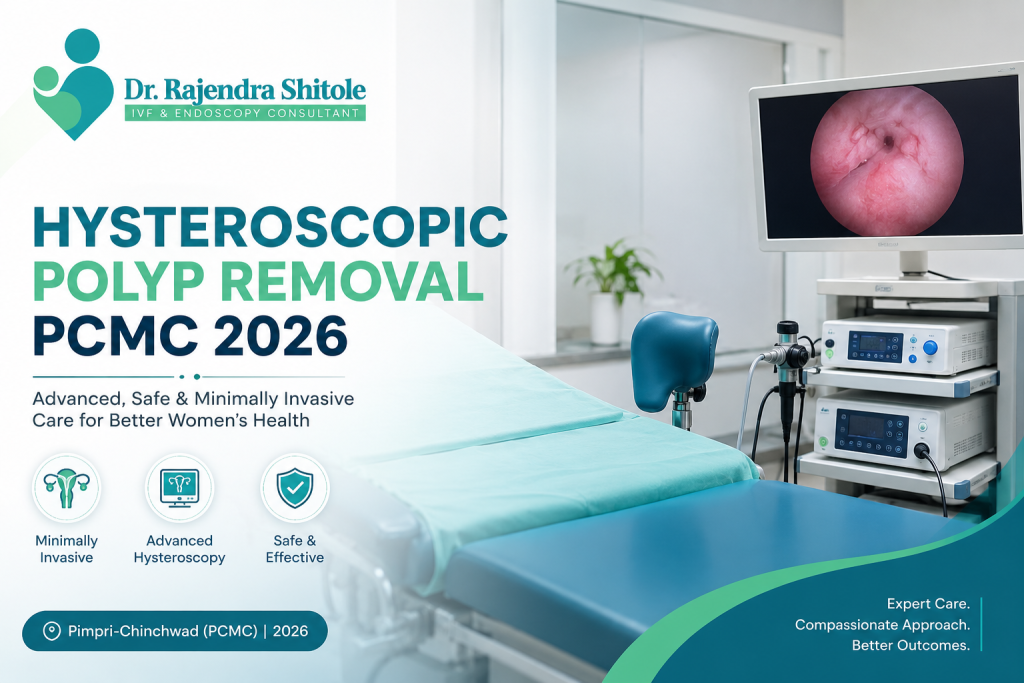
The procedure begins with IV sedation. Dr. Shitole gently passes the hysteroscope through the cervix into the uterine cavity, distended with saline for visibility. The polyp is identified and removed using a small resectoscope loop or mechanical tissue removal device — cutting the polyp at its base while preserving surrounding endometrium.
The removed tissue is sent for histopathology to confirm it is benign. The entire procedure takes 20 to 30 minutes. After 30 to 60 minutes in the recovery area, patients return home the same day. Mild spotting for 2 to 5 days is normal. IVF can typically begin 6 to 8 weeks after polypectomy — once the endometrium has healed and a follow-up scan confirms a clear cavity.
Surgical Risks of Hysteroscopic Polypectomy
| Risk | Frequency | Management |
| Uterine perforation | Less than 0.5 percent | Conservative management in most cases |
| Infection | Less than 1 percent | Prophylactic antibiotics |
| Incomplete removal | Possible with large polyps | Repeat hysteroscopy if needed |
| Intrauterine adhesions (Asherman’s) | Very rare with polypectomy | Hormonal treatment post-op if occurs |
| Recurrence of polyp | 15 to 25 percent at 3 years | Monitoring scan at follow-up |
Post-Operative Care After Polypectomy in PCMC
- Light spotting or discharge: Normal for 3 to 5 days
- Mild cramping: Manage with paracetamol — resolves within 48 hours
- Avoid tampons, intercourse and swimming: For 1 week
- Resume desk work: Next day in most cases
- Follow-up scan: At 6 to 8 weeks to confirm clear cavity before IVF
- Call clinic if: fever above 38 degrees, heavy bleeding, severe pain
Polypectomy Before IVF — Why Every Millimetre Matters
A study published in PubMed 2021 showed that women with uterine polyps who had polypectomy before IVF had implantation rates comparable to polyp-free women — while those who underwent IVF without removing the polyp had significantly lower success rates. For a procedure that takes 30 minutes and costs INR 20,000 to 45,000, the benefit-to-cost ratio is among the highest in fertility medicine.
A 30-year-old woman from Akurdi came to Dr. Shitole’s PCMC clinic after her first IVF cycle at another centre failed despite a good blastocyst transfer. A repeat saline sonography revealed a 1.5 cm endometrial polyp missed on earlier scans. After hysteroscopic removal, her next IVF cycle was successful on the first attempt.
Uterine Polyps and Polypectomy in PCMC — Local Context
Uterine polyps are common across all age groups in PCMC but are particularly prevalent in women aged 30 to 45 in the context of infertility investigation. Women in the PCMC IT and administrative workforce who delay their first fertility consultation often arrive with polyps that have been growing undetected for years. A pelvic ultrasound — ideally a saline infusion sonography — is the most reliable non-invasive screening tool.
Dr. Shitole’s clinic at D.Y. Patil Hospital, PCMC offers same-week hysteroscopy scheduling for women with confirmed or suspected polyps on ultrasound. The aim is to clear the uterine cavity efficiently so IVF can begin without further delay.
Frequently Asked Questions
Q: What is the cost of hysteroscopic polyp removal in PCMC in 2026?
Hysteroscopic polypectomy in PCMC costs INR 20,000 to 45,000 all inclusive — covering anaesthesia, the procedure, histopathology of the removed tissue and post-procedure medications. An itemised quote is provided at your pre-procedure consultation with Dr. Shitole.
Q: Does removing a uterine polyp improve IVF success?
Yes. Multiple studies, including PubMed 2021, show that removing uterine polyps before IVF significantly improves implantation rates — bringing them back to the level of polyp-free patients. For a 30-minute procedure, polypectomy offers excellent value in improving IVF outcomes.
Q: Is polypectomy painful?
The procedure is performed under IV sedation — you are comfortable and unaware throughout. Post-procedure cramping is mild and resolves within 24 to 48 hours with standard pain relief. Most women return to normal activities the next day.
Q: Are uterine polyps cancerous?
The vast majority of uterine polyps are benign. Fewer than 1 percent are malignant (Industry estimate). All removed polyp tissue at Dr. Shitole’s PCMC clinic is sent for histopathology — so the diagnosis is confirmed and any rare finding is acted upon immediately.
Q: How long after polypectomy can I start IVF in PCMC?
IVF can typically begin 6 to 8 weeks after polypectomy — once the endometrium has healed and a follow-up scan confirms the cavity is clear. Dr. Shitole will schedule your follow-up scan and confirm your IVF start date at your post-procedure review.
Q: Can polyps come back after removal?
Yes. Polyp recurrence rate is 15 to 25 percent within 3 years (Industry estimate). For women who have completed their family, hormonal treatments can reduce recurrence. For women planning IVF, the goal is to proceed promptly after removal so the cavity remains clear during treatment.
Conclusion
Hysteroscopic polyp removal in PCMC is one of the simplest, safest and most impactful pre-IVF procedures available. At INR 20,000 to 45,000 for a 30-minute day procedure, it corrects a confirmed cause of IVF implantation failure and gives your next cycle the best possible uterine environment.
If you’ve had a failed IVF cycle or have been advised to check your uterine cavity before treatment, book a hysteroscopy consultation with Dr. Shitole at D.Y. Patil Hospital, PCMC today.
Visit to schedule your appointment.

Dr. Rajendra Shitole
Dr. Rajendra Shitole, Best IVF & Fertility Specialist Centre in Kharadi, Pune .He is highly skilled Gynaecologist, Fertility Consultant, and Laparoscopic & Robotic Surgeon with over 11 years of experience dedicated to women’s health and reproductive care. His mission is to help childless couples fulfill their dream of parenthood through compassionate care and advanced medical expertise.
He has successfully managed numerous complex cases of Infertility, Fibroids, PCOS, Adenomyosis, Endometriosis, and Male Factor Infertility.