KEY TAKEAWAYS
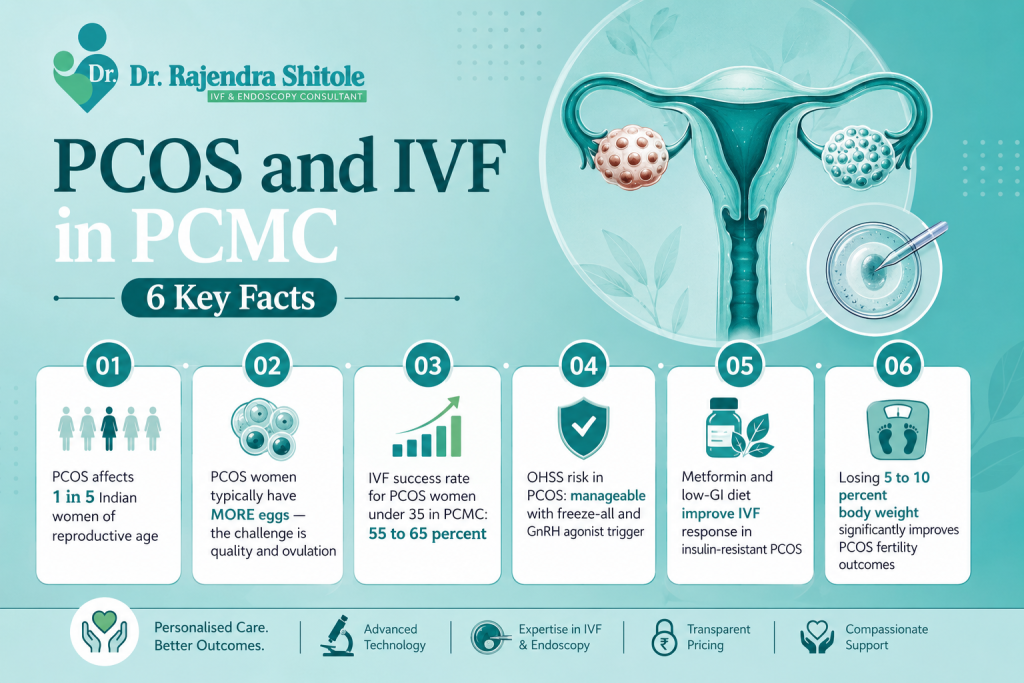
PCOS affects approximately 1 in 5 Indian women of reproductive age and is the most common cause of anovulatory infertility.
Women with PCOS typically produce more eggs per IVF cycle — the key challenge is managing ovarian hyperstimulation syndrome (OHSS).
IVF success rates for PCOS women under 35 in PCMC are 55 to 65 percent per cycle with appropriate protocols.
Dr. Shitole uses a freeze-all strategy with GnRH agonist trigger for PCOS patients to eliminate OHSS risk.
Losing 5 to 10 percent body weight before IVF significantly improves hormonal balance and stimulation response in PCOS.
Metformin and a low-glycaemic Indian diet reduce insulin resistance, improving IVF outcomes in insulin-resistant PCOS.
Does PCOS Affect IVF Success in PCMC?
PCOS IVF success in PCMC is a question Dr. Shitole’s clinic addresses every day. The reassuring answer is this: women with PCOS often do very well in IVF — sometimes better than patients without PCOS — because they produce more eggs per stimulation cycle. The challenge is not egg number; it’s managing the risk of ovarian hyperstimulation syndrome (OHSS) and ensuring egg quality is optimised.
PCOS (Polycystic Ovary Syndrome) is a hormonal condition affecting approximately 1 in 5 Indian women, making it the most common cause of anovulatory infertility (ICMR 2024). It’s characterised by irregular or absent ovulation, elevated androgens (testosterone) and multiple small follicles on the ovaries. This blog, reviewed by Dr. Rajendra Shitole, explains exactly how PCOS affects IVF and what tailored protocols are used at his PCMC clinic to maximise success.
QUICK FACTS
PCOS Prevalence in India: 1 in 5 women of reproductive age (ICMR 2024)
PCOS Share of Anovulatory Infertility: Over 70 percent
IVF Success Rate (PCOS, under 35): 55 to 65 percent per cycle
OHSS Risk in PCOS without precautions: Up to 20 percent of cycles
OHSS Risk with freeze-all and GnRH agonist trigger: Near zero
BMI target for optimal PCOS IVF outcomes: 18.5 to 24.9 kg/m2
PCMC PCOS and IVF Statistics 2025-2026
| Metric | Data Point | Source |
| PCOS prevalence in India | Approx. 1 in 5 women | ICMR 2024 |
| PCOS share of anovulatory infertility | Over 70 percent | ICMR 2024 |
| Average egg retrieval in PCOS IVF cycle | 12 to 25 eggs | Industry estimate |
| IVF success rate (PCOS, under 35) | 55 to 65 percent per cycle | Industry estimate |
| OHSS risk without modification | Up to 20 percent | Industry estimate |
| OHSS risk with GnRH agonist trigger and freeze-all | Near zero | PubMed 2022 |
| Improvement with weight loss before IVF (PCOS) | Significant hormonal improvement | Industry estimate |
| Insulin resistance prevalence in PCOS | 50 to 70 percent of cases | ICMR 2024 |
How PCOS Affects the IVF Process — The Key Challenges
Challenge 1 — Ovarian Hyperstimulation Syndrome (OHSS)
PCOS ovaries are hypersensitive to gonadotropin stimulation. When standard IVF doses are used, PCOS patients can produce 20 or more follicles in a single cycle — creating a risk of OHSS, a potentially serious complication involving fluid accumulation, bloating, nausea and in severe cases, clotting and hospitalisation.
Dr. Shitole eliminates this risk through the freeze-all strategy: instead of doing a fresh embryo transfer in the same cycle as stimulation, all embryos are frozen and transferred in a separate, calmer frozen embryo transfer (FET) cycle. A GnRH agonist trigger injection is used instead of hCG to trigger egg maturation — this reduces OHSS risk to near zero while preserving embryo quality.
Challenge 2 — Insulin Resistance and Egg Quality
50 to 70 percent of PCOS patients have insulin resistance — a metabolic condition where cells don’t respond properly to insulin, leading to elevated blood sugar and compensatory high insulin levels. High insulin levels worsen androgen production in the ovaries, disrupting egg development. Metformin, a medication that improves insulin sensitivity, is used pre-IVF for 8 to 12 weeks in insulin-resistant PCOS patients at Dr. Shitole’s clinic. It improves egg quality and stimulation response.
Challenge 3 — Irregular Cycles and Protocol Timing
PCOS women with irregular or absent periods require hormonal preparation before starting an IVF cycle. This usually involves a short course of oral contraceptives or progesterone to regulate the cycle before stimulation begins. Dr. Shitole’s team schedules this efficiently so cycle start is predictable and preparation is complete.
Dr. Shitole’s PCOS IVF Protocol at His PCMC Clinic
| Protocol Element | PCOS-Specific Modification | Why It Matters |
| Stimulation dose | Low-dose gonadotropins (gentle start) | Reduces OHSS risk in hyper-responders |
| Trigger injection | GnRH agonist instead of hCG | Eliminates OHSS without compromising egg maturity |
| Fresh vs frozen transfer | Freeze-all embryos; FET in next cycle | Uterine environment better in FET after OHSS risk cycle |
| Metformin pre-treatment | 8 to 12 weeks for insulin-resistant PCOS | Improves egg quality and stimulation response |
| Diet preparation | Low-GI diet 3 months before cycle | Reduces insulin resistance |
| BMI optimisation | Target BMI 18.5 to 24.9 before cycle | Significantly improves outcomes |
Diet and Lifestyle for PCOS Women Before IVF in PCMC
The right diet can meaningfully improve PCOS IVF outcomes. Here’s what Dr. Shitole recommends for PCMC patients:
| Dietary Principle | PCOS-Specific Benefit | Indian Food Examples |
| Low glycaemic index (GI) foods | Reduces insulin spike, lowers androgens | Brown rice, jowar, bajra, oats, dals |
| High protein breakfast | Reduces androgen levels (clinical evidence) | Eggs, paneer, sprouts, Greek yogurt |
| Anti-inflammatory foods | Reduces PCOS-related inflammation | Turmeric, ginger, berries, leafy greens |
| Reduce refined sugar | Lowers insulin resistance | Avoid maida, packaged sweets, sugary drinks |
| Omega-3 fatty acids | Reduces androgen and improves ovulation | Flaxseed, walnuts, fish |
| Inositol supplement | Improves insulin sensitivity in PCOS | Supplement — consult Dr. Shitole for dose |
PCOS and IVF in PCMC — Local Context
PCOS is prevalent across PCMC’s diverse demographic — from IT professionals in Hinjewadi to homemakers in Bhosari and Moshi. The sedentary lifestyle, high-carbohydrate diet (bread, rice, packaged food) and chronic stress patterns common in PCMC’s working population all worsen insulin resistance and PCOS severity. Dr. Shitole’s clinic at D.Y. Patil Hospital sees significant numbers of PCOS patients from Wakad, Chinchwad, Nigdi, Akurdi and Talegaon Dabhade.
A 29-year-old IT professional from Wakad came to Dr. Shitole’s clinic with irregular periods since age 19. Diagnosed with PCOS, she had tried Clomiphene for 4 cycles without success. Dr. Shitole started her on Metformin, a low-GI diet and a structured exercise plan for 3 months before her IVF cycle. With a gentle stimulation protocol and freeze-all strategy, 18 eggs were retrieved, 14 were mature, 9 fertilised and 4 good-quality blastocysts were frozen. Her first FET cycle resulted in a successful singleton pregnancy.
Women-specific note: PCOS-associated androgen excess often causes significant psychological distress — acne, weight gain, hair loss. Dr. Shitole’s team addresses these concerns holistically, with dermatology and nutrition referrals available alongside fertility treatment.
Frequently Asked Questions
Q: Can women with PCOS get pregnant with IVF in PCMC?
Yes. Women with PCOS under 35 have IVF success rates of 55 to 65 percent per cycle at established PCMC clinics with appropriate protocols. PCOS women typically produce more eggs, which is an advantage. The main risk — OHSS — is effectively managed with the freeze-all and GnRH agonist trigger approach used by Dr. Shitole.
Q: What is OHSS and is it dangerous?
Ovarian Hyperstimulation Syndrome (OHSS) occurs when ovaries over-respond to stimulation, producing excess fluid. Mild OHSS causes bloating and discomfort. Severe OHSS (rare) can cause breathing difficulty and clotting. Dr. Shitole’s PCOS-specific protocol reduces OHSS risk to near zero by using a GnRH agonist trigger and freezing all embryos for transfer in a separate calmer cycle.
Q: Does losing weight really improve IVF success with PCOS?
Yes. Even a 5 to 10 percent reduction in body weight in overweight PCOS patients significantly improves insulin sensitivity, lowers androgen levels and improves ovarian stimulation response. This translates to better egg quality and higher IVF success rates. A nutritionist referral is available at Dr. Shitole’s PCMC clinic.
Q: How long does PCOS IVF preparation take in PCMC?
A: For most PCOS patients, 8 to 12 weeks of preparation — Metformin, diet modification, cycle regulation — is recommended before the stimulation cycle starts. This improves outcomes measurably. Urgent cases can start sooner with a modified protocol.
Q: Can PCOS affect egg quality even when egg numbers are high?
Yes. PCOS can impair oocyte quality due to insulin resistance, androgen excess and irregular follicular development. Metformin pre-treatment, inositol supplements and low-GI diet have all been shown to improve oocyte quality in PCOS patients (PubMed). Your embryologist will assess fertilisation and blastocyst rates after retrieval.
Q: Is IUI or IVF better for PCOS in PCMC?
For PCOS with no other infertility factors, ovulation induction (Clomiphene or Letrozole) with IUI is a reasonable first-line treatment. After 3 to 4 failed IUI cycles, or in women over 35 or with additional infertility factors, IVF is more effective. Dr. Shitole will recommend the most efficient pathway based on your full clinical picture.
Conclusion
PCOS IVF success in PCMC is very achievable with the right specialist and the right protocol. Women with PCOS have a genuine fertility advantage in terms of egg numbers — the key is managing stimulation safely and optimising egg quality through targeted lifestyle and medical preparation.
Dr. Rajendra Shitole at D.Y. Patil Hospital, Pimpri-Chinchwad has helped hundreds of PCMC women with PCOS achieve successful pregnancies through IVF. His tailored PCOS protocols, freeze-all strategy and holistic preparation approach deliver consistently strong outcomes.
Book your PCOS and IVF consultation at drrajendrashitoleivfdoctor this Women’s Health Month.
A PCOS diagnosis is not a barrier to pregnancy. It’s a condition you can work with — and Dr. Shitole’s team knows exactly how.
Dr. Rajendra Shitole
Dr. Rajendra Shitole, Best IVF & Fertility Specialist Centre in Kharadi, Pune .He is highly skilled Gynaecologist, Fertility Consultant, and Laparoscopic & Robotic Surgeon with over 11 years of experience dedicated to women’s health and reproductive care. His mission is to help childless couples fulfill their dream of parenthood through compassionate care and advanced medical expertise.
He has successfully managed numerous complex cases of Infertility, Fibroids, PCOS, Adenomyosis, Endometriosis, and Male Factor Infertility.